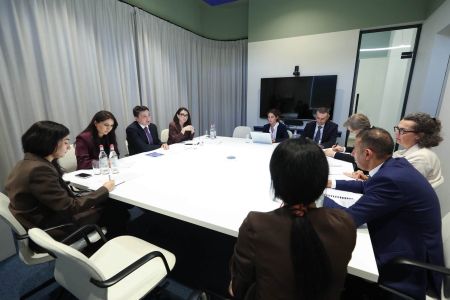
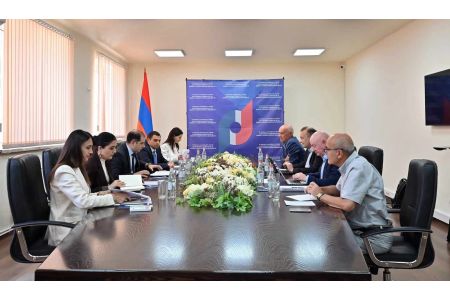
ArmInfo. The staff of the Macroeconomic Policy Department of the Ministry of Finance of the Republic of Armenia, together with experts from the International Monetary Fund (IMF), continued to develop a semi-structural model (Semi-Structural Gap Model/SSGM) for medium-term forecasting of macroeconomic indicators within the framework of technical assistance.
In particular, according to the Ministry of Finance, work was carried out to optimize and refine the calibration of the parameters of the semi-structural model for quarterly forecasting, test the predictive power of the model based on initial assumptions, and implement forecasts with basic and alternative scenarios. In the near future, it is planned to use the semi-structural model in the forecasting period of the budget process.
"The Ministry of Finance of the Republic of Armenia strives to continuously improve and supplement the analytical system for developing economic policy with world-famous, popular and modern tools, solutions and approaches>, - the financial department noted.
SSGM or semi-structural gap model is a type of macroeconomic model that combines elements of structural and reduced models. It seeks to balance the rigor of economic theory with the flexibility of empirical data analysis. These models are often used for forecasting and policy analysis, especially in central banks.
The forecasts of the International Monetary Fund (IMF) and the World Bank (WB), updated in April of this year, predict an almost similar slowdown in GDP growth for Armenia in 2025 to 4.5% and 4%, respectively, with the WB expecting an acceleration in 2026 to 4.2%. The Asian Development Bank (ADB), according to the April forecast update, expects Armenia's GDP growth in 2025 to be 5% with a slowdown in 2026 to 4.7%. The Eurasian Development Bank (EDB) predicts an almost similar slowdown in Armenia's GDP growth in 2025 to 4.7%, and in 2026-2027 the rates will fluctuate in the range of 4-5%. According to the Statistical Committee of the Republic of Armenia, Armenia's GDP growth in 2024 slowed to 5.9% (from 8.3% in 2024 and 12.6% in 2023), exceeding 10.193 trillion drams ($26 billion). The draft budget for 2025 envisages GDP growth of 5.1%.
The Republic of Armenia became a member of the IMF on April 28, 1992. In October last year, as a result of the IMF mission to Armenia, which took place from September 18 to October 1, 2024, and subsequent discussions, a working agreement was reached on the fourth review of the three-year IMF-supported Reserve Arrangement. The review was approved by the IMF Executive Board in December 2025, after which $24.5 million (SDR 18.4 million) became available to the republic. This brings the total amount of available funds to $122.7 million (SDR 92 million). The program is of a preventive nature, and the borrowed funds are aimed at meeting the external financial needs of the economy arising from possible future shocks.