


ArmInfo. The size of Armenia's public debt may decrease in the near future. This will be done not by repaying previously taken public loan obligations, but by fundamentally revising the legislation regulating public debt. "The introduction of amendments does not aim to whet the appetite of the country's economic authorities to attract new - 'legally unlimited' borrowings, but is only conditioned by the need to meet the requirements of the international standard established in relation to public debt," Acting Head of the Public Debt Management Department of the Ministry of Finance of the Republic of Armenia Marine Melikyan said in an interview with ArmInfo.
Things of past:
Currently, Armenia's public debt includes the debt obligations of the government itself, which arise due to a budget deficit and the need to attract additional funds to cover it, as well as the Central Bank of the country. The government debt, in turn, is divided into external and internal (including loans issued under the government's guarantee, which are reflected in the column of the external debt of the Central Bank). In the first case, these are the debt obligations of the RA government to international organizations and foreign countries, as well as funds received from the issue of Eurobonds, and in the case of internal debt, these are its obligations to the residents of the country.
Back in the summer of 2015, amendments were made to the RA Law On State Debt, which established 'dividing lines> between the debt of the government and the Central Bank. The previous law limited the volume of external debt in relation to GDP at 60%, that is, the law did not allow the debts taken by the government and the Central Bank to exceed 60% of the country's GDP in total. Thus, as a result of mechanical changes, it was recorded that Armenia's external debt did not exceed the permissible threshold. Thus, the government was given leeway to attract new credit funds, and the Central Bank received additional opportunities for new loans.
By amending the laws and in 2017, the Ministry of Finance proposed to provide for three thresholds for the level of government debt - 40%, 50% and 60% for the medium and long term. Thus, when the 40% debt threshold is exceeded, capital expenditures must exceed the state budget deficit. When the 50% norm is exceeded, the requirements are tightened, and in addition to the previous requirement, restrictions are set on current expenditures. It was noted that in this way, the 'golden rule' of debt will work, which provides for the possibility of financing exclusively capital expenditures through borrowing. Approaches are further tightened after the debt exceeds 60% of GDP - current expenditures are linked to domestic revenues, especially tax revenues. In addition, if previously the permissible debt threshold of 60% was set in relation to GDP for the previous year, then according to the new regulations the ratio to GDP was fixed for the current year. At the same time, in the event of force majeure - a global natural disaster, war - in the conditions of a crisis economy, the government was allowed to exceed the 60% mark. Having exceeded this permissible threshold, the law obliged the government to submit to the National Assembly a program that would show how the Cabinet of Ministers plans to reduce the level of public debt.
Things of future
However, if all previous changes were 'situational in nature', the current amendments imply a revision of the entire 'philosophy' of public debt. Thus, the Ministry of Finance proposes to once again revise the concept of 'public debt' - excluding from it the external debt of the Central Bank and state guarantees, while including the debt of communities.
The goal, as Marine Melikyan emphasizes, is to keep up with the times. 'All over the world, public debt includes government debt and community debt. In no country in the world is the debt of the Central Bank considered part of the public debt. As a result of the amendments, we are introducing a new concept - 'public sector debt' (Public sector debt), which represents the totality of public debt, the debt of state financial and non-financial organizations of the public sector. That is, if we imagine a pyramid, then at its top (and the largest in terms of volume) will be
In addition, the Ministry of Finance defines the concept of , and also describes the powers of local authorities to attract loans. The funds attracted by communities (there are not many precedents - only the Yerevan community has a loan received from the EIB, and then, with the approval of the Ministry of Finance), are only 'by default' considered part of the state debt. The current law only obliges communities to attract a new loan only after the old one is repaid. Now, in order to mitigate risks for the state, the Ministry of Finance proposes to limit the ability of communities to attract loans - by giving them the opportunity to take loans only from internal sources, since it considered that "there are still problems with the development of municipal potential". "For now, we will give communities the opportunity to work with the internal financial market, issue bonds, take dram loans from banks", - explained the representative of the Ministry of Finance.
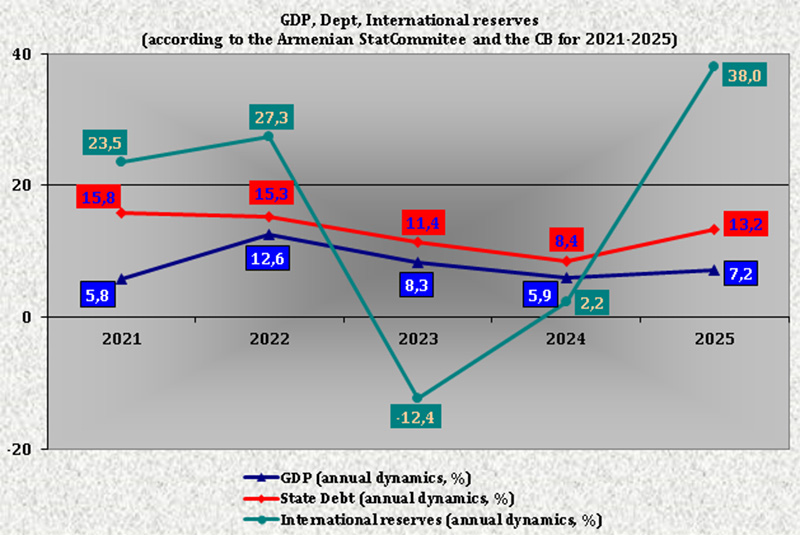
To understand the scale of the proposed changes, we note: in accordance with the terminology still in effect, for January-July 2025, the state debt of Armenia in dollar terms increased by approximately $ 1 billion 256 million - from $ 12 billion 842.2 million by the end of 2024 to $ 14 billion 098.6 million. However, as a result of the planned adjustments, the figure will decrease. It will lose its Central Bank debt (200.9 billion drams or $523.3 million), the Yerevan community debt will be added to it (5.3 million euros) and the state debt according to the new classification will amount to $13 billion 279 million.
At the same time, the acting head of the department of the agency assures that this does not mean at all that the government is taking such a step out of the need to get another slack to attract new credit funds and a purely visual reduction in the debt burden, since the current thresholds for increasing the government debt remain the same. The Cabinet of Ministers, as before, will be limited by them, since the structure of the government debt itself will remain the same. Well, perhaps it will be slightly lightened - guarantees will be removed from its composition (by the end of July, the figure reached 26.8 billion drams).
It is important that the Ministry of Finance of the Republic of Armenia also proposes to review the goals of attracting public debt, as well as the main goal of managing public debt in accordance with new regulations and best international practices.
"The current regulations provide for a reduction in the volume of interest rate payments in the long term. However, when managing debt, it becomes obvious that it is impossible to reduce interest rates for servicing it in absolute terms with a physical increase in debt in the long term," Melikyan explains. As for the purposes of attracting public debt, in addition to the purposes of covering the budget deficit, the possibility of attracting debt also to replenish the government's stabilization fund is being secured.
It is not that simple
At the same time, Armenia is still not going to refuse budget support loans, despite the fact that the country's financial authorities have been declaring their readiness to refuse external financial assistance in the form of budget loans since 2019, and then since 2021, by switching to targeted lending to strengthen the foundations of the economy. As then Finance Minister Atom Janjughazyan told an ArmInfo correspondent at the end of 2020, today many consider this instrument to be quite attractive, since a budget support loan differs from other types of borrowing in that it does not have a specific targeted spending program and is provided on preferential terms. However, such preferential loans are dangerous because the country may become completely dependent on external borrowing, the minister noted.
"If you want to actively intervene in the economic development of the country, you always spend more than your income allows. And this, in the current conditions, is impossible to do without budgetary assistance loans," concluded Marine Melikyan, with whom it is difficult to disagree.