

ArmInfo.Armenia will undergo a "rebranding" of its public debt. At its October 13 meeting, the Committee on Financial, Credit, and Budgetary Affairs of the National Assembly of the Republic of Armenia approved amendments to the laws "On the State Share," "On the Budget System," and "On Funds" submitted by the government.
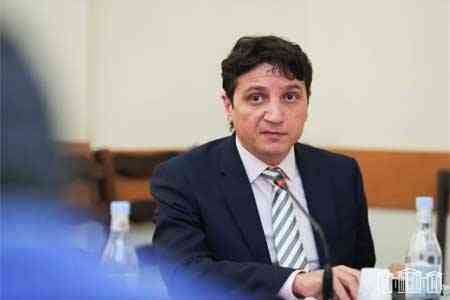
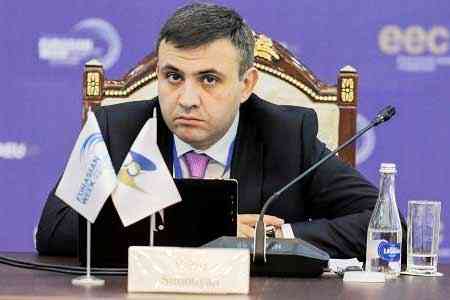
Presenting the amendments, Deputy Minister of Finance Avag Avanesyan noted that the package envisages the exclusion of loans raised by the Central Bank of the Republic of Armenia or secured under state guarantees from the public debt. In turn, resources raised by local governments, particularly Yerevan, will be included in the public debt. Avag Avanesyan emphasized that the proposed initiative is the result of the Ministry of Finance's active collaboration with the International Monetary Fund, aimed at addressing the issue of accurate reporting and the calculation of key financial indicators. In accordance with the three-year IMF program, Armenia has accepted the above-mentioned precondition, which is also very important for attracting new loans and international securities.
Another change, as the Deputy Minister noted, concerns the efficiency of decisions regarding changes to international loan and securities rates. It often happens that partners submit proposals for changes that require promptness, while the Armenian side is forced to seek permits and other bureaucratic procedures. Now, the Ministry of Finance will have this opportunity. Avag Avanesyan emphasized that the package also provides for the Armenian government to impose a moratorium on borrowing. This can occur if the national debt exceeds 60% of GDP. In this case, permission from the National Assembly of the Republic of Armenia will be required. This right will also apply if the national debt, together with contingent liabilities from previous years, approaches 70%. All liabilities are currently registered with the State Treasury. However, it is important to distinguish between the concepts of "liabilities" and "contingent liabilities." The latter were not recorded in the Treasury. Now, they will also be calculated by the Ministry of Finance. This concerns guarantees for loans raised by the private sector. For example, these could be companies in the aviation, energy, and railway sectors.
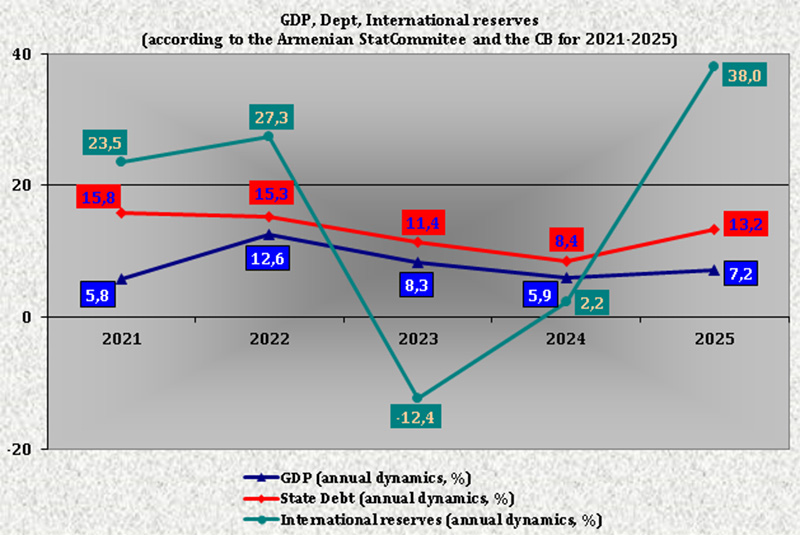
Avag Avanesyan emphasized that the adoption of the package will reduce the "public debt to GDP" ratio by 2%, primarily due to the Central Bank's debt. Guarantees will account for 0.2% of this 2%. At the end of 2024, the country's public debt to GDP was approximately 50%.
It should be noted that, according to the current terminology, Armenia's public debt in dollar terms increased by approximately $1.256 billion from January to July 2025, from $12.842.2 billion by the end of 2024 to $14.098.6 billion. However, following the planned adjustments, this figure will decrease. It will "lose" the Central Bank debt (200.9 billion drams or $523.3 million), the debt of the Yerevan community will be added to it (5.3 million euros), and the state debt according to the new classification will amount to $13 billion 279 million.