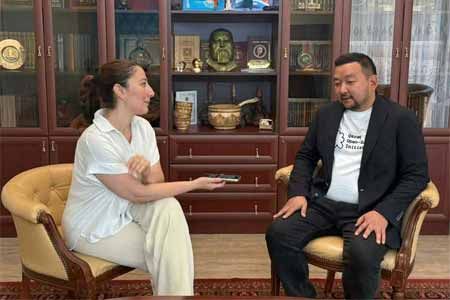


ArmInfo. The Swiss Agency for Strategic Development (SDA) is launching the "INNOVATIVE LIVESTOCK MANAGEMENT: ANIMAL MIGRATION, BREEDING & MARKETS - INLIMA" program in Armenia. Program Director Vahe Hovhannisyan told an ArmInfo correspondent that the project will cover seven regions of the country, namely: Syunik, Vayots Dzor, Gegharkunik, Armavir, Aragatsotn, Ararat, and Shirak. The program will be implemented until April 2029. The Austrian Development Agency (ADA) is the donor. According to the agency's website, INLIMA's budget is 2.1 million euros.
As Hovhannisyan noted, the program is aimed at sustainable livestock management and the introduction of innovative methods. INLIMA has three components. According to its director, the first component involves establishing a coordinated cattle route as a pilot project in Syunik. The responsible agencies will work to expand this experience to all regions of Armenia where livestock is raised. "Considering numerous problems caused by cattle movement on highways, including accidents, collisions, missing animals, etc., a cattle route will be created through pastures equipped with special resting and watering areas," Hovhannisyan clarified.
The second component involves establishing a breeding station for pedigree cattle. The agency intends to promote artificial insemination of cattle. The station, as he further explained, will also kickstart local seed production. "Since the collapse of the USSR, such production has not existed in Armenia," the head of INLIMA noted.
The third component involves cooperation with key players in the meat and dairy markets in two areas. The first, as Hovhannisyan noted, is stimulating dialogue between farmers and representatives of responsible government agencies to address industry issues. Furthermore, plans include increasing productivity in the meat and dairy sector, developing investment programs through co-financing, and assisting in compliance with food safety standards and improving technological conditions.
He also noted that there has been some progress the industry in recent years. In particular, Armenia now has farms and processing plants equipped with advanced technologies. " There has certainly been improvement compared to several years ago. However, there are still numerous problems that need to be addressed with comprehensive solutions," he concluded.
It should be noted that, according to the RA Statistics Committee, at the beginning of 2025, there were 475,835 head of cattle in Armenia, a 3.2% year-on-year decrease. According to the Customs Service, in the first half of 2025, Armenia exported 4,100 head of cattle, a 52.3% decrease compared to the previous year, while the customs value decreased by 59.3% to $2.3 million. Imports, on the other hand, totaled 3,400 head of cattle, a 5.5-fold increase compared to the previous year, with the customs value increased by 28.2% to $1.2 million. From January to September 2025, 70,100 tons of live weight cattle and poultry were sold for slaughter in Armenia, indicating a 1.3% increase compared to the same period last year. During the reporting period, 486.6 thousand tons of milk were produced, showing an annual decrease of 1.4%.