

ArmInfo. The slowdown in economic growth outside Armenia, in the CIS countries and trading partners, including Russia, is the main risk for the Armenian economy in the forecast for 2026-2028, according to analysts at the Eurasian Development Bank (EDB).
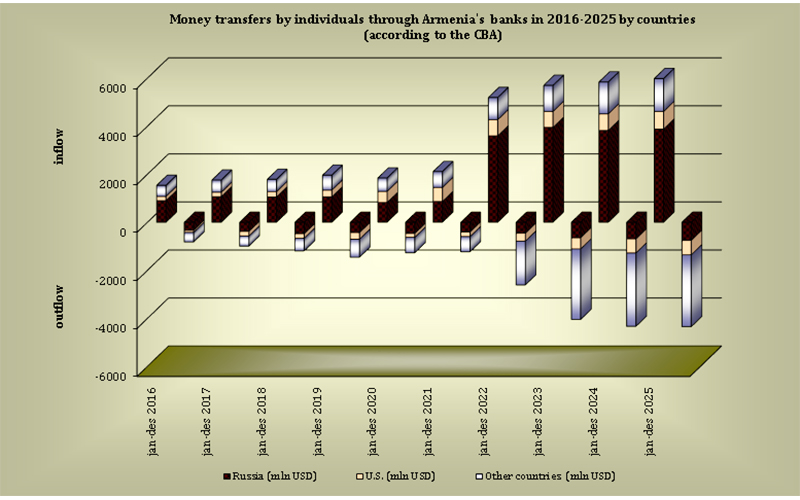
Aleksey Kuznetsov, EDB Analytical Directorate Head, noted that a slowdown in the economies of Armenia's partner countries could impact Armenia's exports and the volume of remittances received. "Therefore, we consider this as one of the main risks in our macroeconomic forecast. However, the baseline scenario still assumes that if the global economy as a whole maintains its slow economic growth rates, there will be no significant changes, either positive or negative. We do anticipate that within the Eurasian region, including the Russian Federation, economic growth rates will nevertheless accelerate in 2026 and remain high as in 2025. This will positively impact economic activity in Armenia," the bank's analyst said.
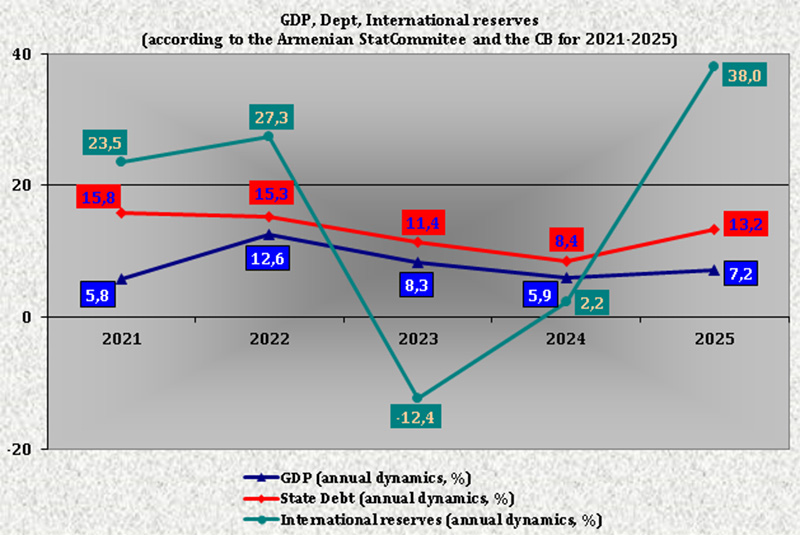
Regarding the volume of government debt, Kuznetsov noted that the Bank does not foresee any risks in this area in the forecast period. "We see that Armenia's public debt in 2020 was 67% of GDP, and now it has dropped to almost 50%, which is a positive trend. Despite some expected increase in public debt by the end of 2025 due to borrowings, it is estimated to reach around 51.5% of GDP. That is, there is no significant acceleration, and, in principle, its level is quite safe," he noted. Kuznetsov acknowledged that Armenia plans to increase public debt to 55% of GDP, but aims to stabilize it within the 50-55% range. "This is a completely normal working result. For example, on average, across developing economies, according to the latest available data, the average level of public debt in economies like Armenia is 95% of GDP," Kuznetsov concluded.
It should be noted that Armenia's public debt reached $14.2 billion by October 2025, raising the per capita debt burden to $4.6 thousand. Specifically, external debt stood at $6.9 billion (2.6 trillion drams), while domestic debt totaled $7.3 billion. Domestic debt began to prevail over external debt in July of this year, steadily increasing its dominance each month by a wider margin.