

ArmInfo. Fitch Ratings has revised the Outlook on Armenia's Long-Term Foreign-Currency (LTFC) Issuer Default Rating (IDR) to Positive from Stable and affirmed the IDR at 'BB-'. A full list of rating actions is at the end of this rating action commentary.
The Outlook revision reflects Armenia's higher international reserves and continued solid growth that will support fiscal consolidation consistent with debt stabilisation over the medium term. The US-sponsored peace framework with Azerbaijan significantly reduces near-term military escalation risks, but lingering uncertainty remains regarding its successful conclusion due to the proximity of parliamentary elections and potential constitutional reform referendum.
KEY RATING DRIVERS
The revision of the Outlook on Armenia's 'BB-' IDRs reflects the following key rating drivers and their relative weights:
Medium
Historic Peace Framework: Armenia and Azerbaijan signed a joint declaration that aims to reach a peace agreement, which significantly reduces near-term military escalation risks. In Fitch's view, the finalisation remains subject to uncertainties as it is conditional on Armenia amending its constitution to remove references to Nagorno- Karabakh, which requires a popular referendum that will potentially take place after the June parliamentary elections. Trade with and through Azerbaijan has begun to open up. Relations with Turkiye are substantially improving, and the Turkish government is reportedly considering reopening its land border with Armenia.
Gradual Fiscal Consolidation: Fitch estimates that the 2025 general government (GG) deficit was 5.0% of GDP, lower than the budgeted 5.5% but still above the 'BB' median (3.0%), reflecting lower capex and interest payments. Armenia's 2026 budget targets a fiscal deficit of 4.5% of GDP based on reduced defence expenditure (down 2.1pp to 4.7% of GDP), while health spending has increased by 0.5% of GDP to fund the phase-in of a universal health insurance system. We expect the government to meet its 4.5% deficit target in 2026, but from 2027 we expect deficits above the authorities' 3.5% medium- term target. Fitch estimates that GG debt increased to 50.1% of GDP at end-2025, and forecasts a gradual increase in coming years closer to the projected 'BB' median of 53.6%, given still sizeable deficits and expected overfinancing.
Robust Growth Prospects: Fitch estimates real GDP growth of 5.5% in 2025 (moderating from an average of 8.9% over 2022-2024 due to Russian capital and migration inflows), driven by strong activity in the construction, IT and financial services sectors. Growth should remain above 5.0% in 2026-2027, supported by resilient services and the opening of the Amulsar gold mine, which the IMF estimates will contribute 1.25pp to GDP growth over 2026-2027. Additional upside to the medium-term growth forecast could emerge from sustained implementation of the peace agreement with Azerbaijan and the reopening of the border with Turkiye.
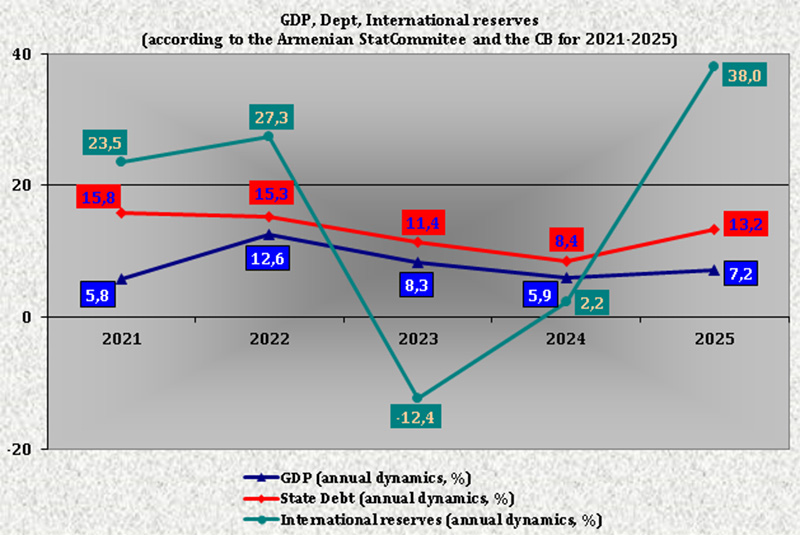
Higher FX Reserves: International reserves rose by 38% to USD5.5 billion in 2025, equivalent to 4.2 months of estimated current external payments for 2025 (current 'BB' median: 5.3 months) due to Eurobond proceeds and central bank purchases in the domestic market. However, Fitch expects reserve coverage will gradually decline in coming years due to projected growth in imports.
Armenia's 'BB-' ratings also reflect the following key rating drivers:
Credit Fundamentals: Armenia's 'BB-' rating reflects a robust macroeconomic policy framework and strong growth, which is supporting a rise in per capita income. Set against these strengths are the small size of the economy, fiscal deficits that are high relative to peers, weak external finances, high (albeit declining) financial sector dollarisation and a fragile geopolitical environment, although peace negotiations have shown some progress.
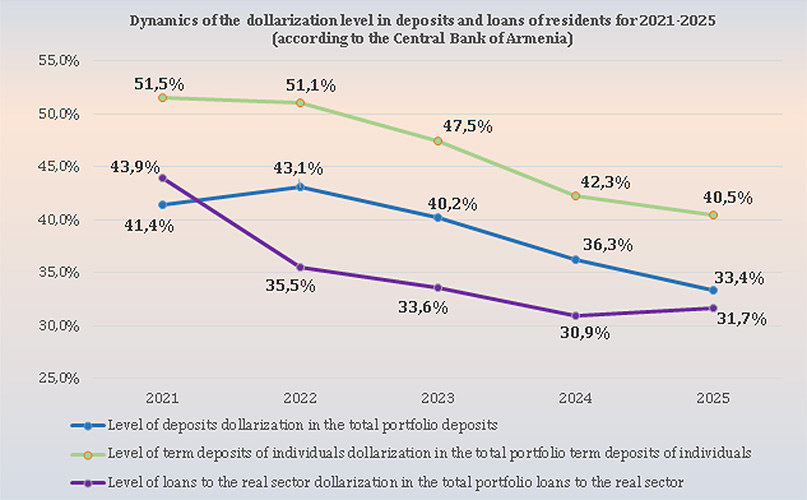
Banking Sector Resilience: Banks have maintained strong capital and liquidity buffers, with profitability remaining high despite the normalisation of extraordinary Russian financial inflows. Dollarisation continues its gradual decline, with deposit dollarisation falling to around 43.3% in November 2025 supported by regulatory measures and increased confidence in the dram.
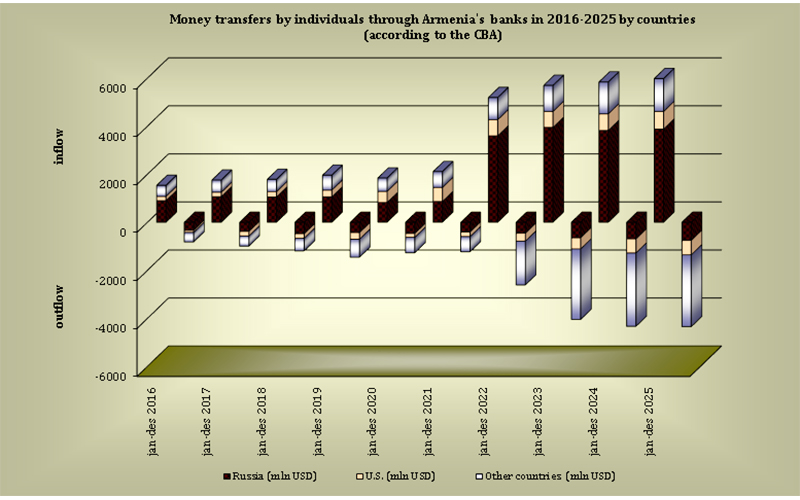
Current Account Deficits Widen: We estimate the current account deficit reached 4.5% of GDP in 2025, and expect it will moderate slightly in 2026-2027 but remain above the projected 'BB' median of 2.6%. A wider trade deficit will be contained by higher gold exports with the anticipated opening of the Amulsar mine this year. Fitch expects a normalisation of remittance inflows, moderating the secondary income surplus.
ESG - Governance: Armenia has an ESG Relevance Score (RS) of '5' for both Political Stability and Rights and '5+' for the Rule of Law, Institutional and Regulatory Quality and Control of Corruption. These scores reflect the high weight that the World Bank Governance Indicators (WBGI) have in our proprietary Sovereign Rating Model. Armenia has a medium WBGI ranking at 45.5 reflecting a moderate level of rights for participation in the political process, elevated but improving geopolitical risks, moderate levels of political stability, moderate institutional capacity and rule of law and a moderate level of corruption.
RATING SENSITIVITIES
Factors that Could, Individually or Collectively, Lead to Negative Rating Action/Downgrade - Structural: Developments that increase geopolitical risks and undermine political and economic stability; for example, derailment of the current peace process with Azerbaijan.
- External Finances: A reversal of improvements in FX reserves that increases external vulnerabilities.
- Public Finances: Macroeconomic or policy developments that steepen the upward path of general government debt/GDP.
Factors that Could, Individually or Collectively, Lead to Positive Rating Action/Upgrade
- Structural: A sustainable decline in geopolitical risk and domestic political uncertainty; for example, as a result of meaningful progress in the peace process with Azerbaijan.
- Public Finances: Fiscal consolidation that supports a stabilisation in general government debt/GDP, while preserving improvements in terms of currency composition.
- Macro: Preservation of high growth rates supporting a sustained increase in GDP per capita.
SOVEREIGN RATING MODEL (SRM) AND QUALITATIVE OVERLAY (QO)
Fitch's proprietary SRM assigns Armenia a score equivalent to a rating of 'BB' on the LTFC IDR scale.
Fitch's sovereign rating committee did not adjust the output from the SRM score to arrive at the final LTFC IDR.
- Structural: We have introduced a new -1 QO notch to reflect lingering geopolitical risks and uncertainties to the nascent peace process, which, should they materialise, could negatively impact current positive trends for growth, public and external finances. Fitch's SRM is the agency's proprietary multiple regression rating model that employs 18 variables based on three-year centred averages, including one year of forecasts, to produce a score equivalent to a LTFC IDR. Fitch's QO is a forward-looking qualitative framework designed to allow for adjustment to the SRM output to assign the final rating, reflecting factors within our criteria that are not fully quantifiable and/or not fully reflected in the SRM.
DEBT INSTRUMENTS: KEY RATING DRIVERS
Senior Unsecured Debt Equalised: The senior unsecured long-term debt ratings are equalised with the applicable Long-Term IDR, as Fitch assumes recoveries will be 'average' when the sovereign's Long-Term IDR is 'BB-' and above.
COUNTRY CEILING The Country Ceiling for Armenia is 'BB', one notch above the LTFC IDR. This reflects moderate constraints and incentives, relative to the IDR, against capital or exchange controls being imposed that would prevent or significantly impede the private sector from converting local currency into foreign currency and transferring the proceeds to non- resident creditors to service debt payments. Fitch's Country Ceiling Model produced a starting point uplift of +1 notch above the IDR. Fitch's rating committee did not apply a qualitative adjustment to the model result.
REFERENCES FOR SUBSTANTIALLY MATERIAL SOURCE CITED AS KEY DRIVER OF RATING The principal sources of information used in the analysis are described in the Applicable Criteria.
CLIMATE VULNERABILITY SIGNALS
The results of our Climate.VS screener did not indicate an elevated risk for Armenia.
ESG CONSIDERATIONS
Armenia has an ESG Relevance Score of '5' for Political Stability and Rights as WBGI have the highest weight in Fitch's SRM and are therefore highly relevant to the rating and a key rating driver with a high weight. As Armenia has a percentile rank below 50 for the respective Governance Indicators, this has a negative impact on the credit profile. Armenia has an ESG Relevance Score of '5' for Rule of Law, Institutional & Regulatory Quality and Control of Corruption as WBGI have the highest weight in Fitch's SRM and are therefore highly relevant to the rating and a key rating driver with a high weight. As Armenia has a percentile rank below 50 for the respective Governance Indicators, this has a negative impact on the credit profile.
Armenia has an ESG Relevance Score of '4+' for Human Rights and Political Freedoms as the Voice and Accountability pillar of the WBGI is relevant to the rating and a rating driver. As Armenia has a percentile rank above 50 for the respective Governance Indicator, this has a positive impact on the credit profile.
Armenia has an ESG Relevance Score of '4[+]' for Creditor Rights as willingness to service and repay debt is relevant to the rating and is a rating driver for Armenia, as for all sovereigns. As Armenia has a record of 20+ years without a restructuring of public debt and captured in our SRM variable, this has a positive impact on the credit profile. The highest level of ESG credit relevance is a score of '3', unless otherwise disclosed in this section. A score of '3' means ESG issues are credit neutral or have only a minimal credit impact on the entity, either due to their nature or the way in which they are being managed by the entity. Fitch's ESG Relevance Scores are not inputs in the rating process; they are an observation on the relevance and materiality of ESG factors in the rating decision. For more information on Fitch's ESG Relevance Scores, visit www.fitchratings.com/topics/esg/products#esg-relevance-scores.
Additional information is available on www.fitchratings.com
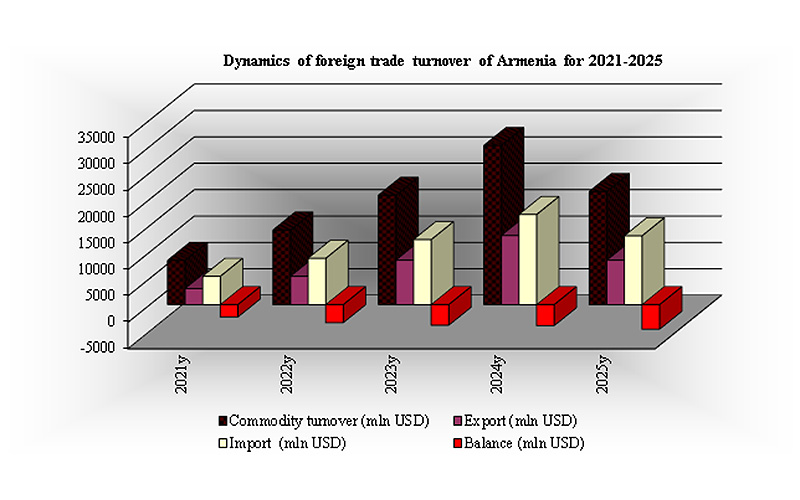
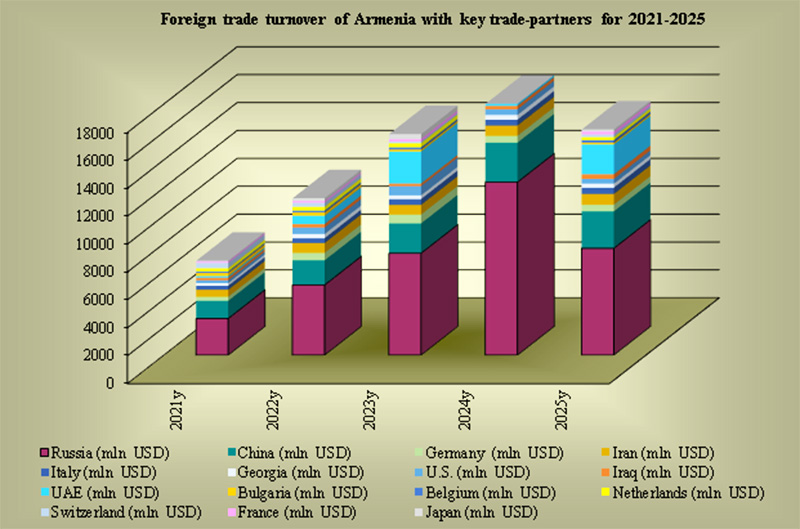
As a reminder, according to the Central Bank of Armenia's updated forecast in December, GDP growth in 2025 is estimated at 5.9% (similar to the actual 5.9% growth in 2024). For 2026, the Central Bank forecasts GDP growth of 6.3-4.1% and then 4.9- 5.3% in 2027, also expecting an improvement in foreign trade dynamics. According to the Central Bank's updated forecast, export and import dynamics, after almost equal growth in 2023 of 30.7-30.2% and a decline in 2024 of 11-3.2%, will deepen into negative territory in 2025 by 37.3-36.1% (for exports) and 32.7-32.5% (for imports). However, already in 2026, the Central Bank expects an improvement in both export growth rates of 4.5-3.4% and import growth rates of 3.1%, with this trend continuing in 2027 to 3.9-4.1% (for exports) and 4.2-3.8% (for imports).
In its December forecast, the IMF indicated that Armenia's GDP growth in 2025 would amount to 5%, accelerating to 5.5% in 2026. Moreover, the IMF forecasts a decline in Armenia's exports and imports by 31.1% and 28.1%, respectively, in 2025, with growth rates returning to almost equal levels in 2026 at 2.2-2.1%, followed by a further moderate acceleration in 2027 to 3.4-3.7%.
In its January forecast, the World Bank predicted a slowdown in Armenia's GDP growth in 2026-2027 to 4.9-4.7% from an estimated 5.2% in 2025 (following a slowdown in 2024 from 8.3% to 5.9% - Ed.).
Armenia's draft state budget for 2025 projects GDP growth of 5.1%, while the 2026 state budget projects 5.4% economic growth.
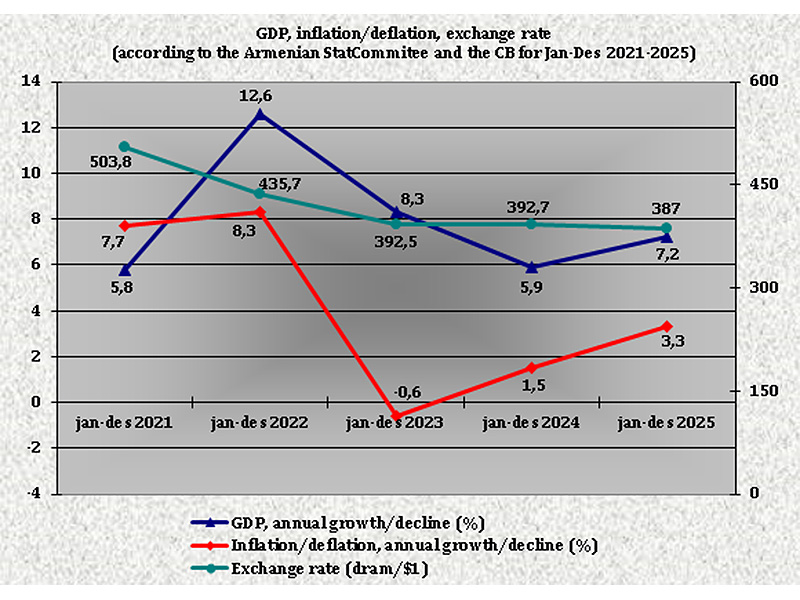
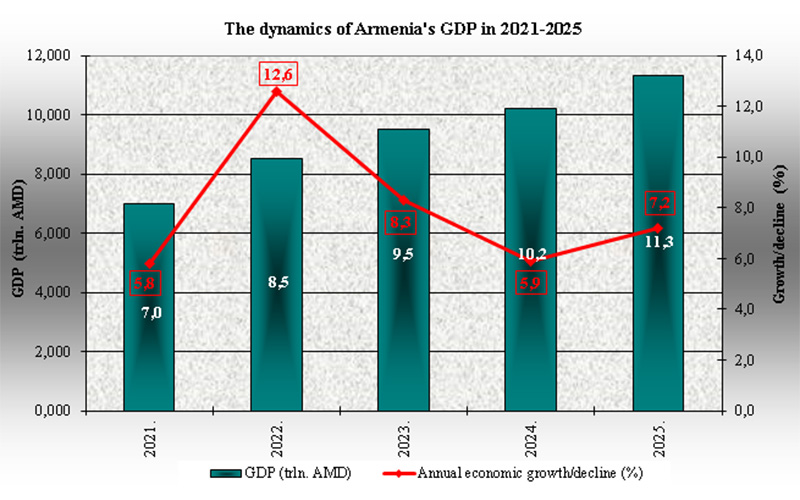
According to the RA Statistics Committee, Armenia's GDP growth, after accelerating from 5.8% to 12.6% in 2022, will slow to 8.3% in 2023 and then to 5.9% in 2024, amounting to 10.2 trillion drams (approximately $26 billion) in absolute terms. The GDP deflator index also, after growing in 2022 from 106.9% to 108%, began to decline to 103.1% in 2023 and to 101.4% in 2024.