

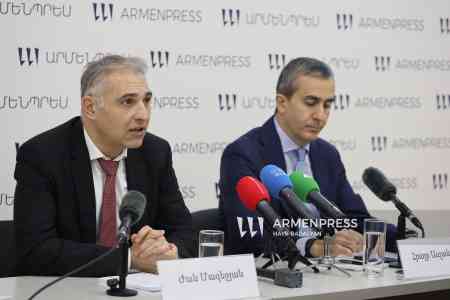
ArmInfo. By December 2025, the number of participants in the three Amundi-Acba Asset Management funds reached 558,000 (510,000 in December 2024), bringing total assets to 750 billion drams, as stated by Jean Mazedjian, Executive Director of Amundi-Acba Asset Management in Armenia, summing up the results of the previous year on February 3.
Mazedjian recalled that the shareholders of Amundi-Acba Asset Management are the French company Amundi (51%), which manages assets of over 2.32 trillion euros (as of September 30, 2025) in 35 countries, and the Armenian Acba Bank (49%), one of the largest financial institutions in Armenia with 66 branches. "Amundi ranks first in Asset Management in Europe and is among the top 10 globally," he noted, emphasizing that the company has solidified its market leadership in Armenia over the past 12 years by blending international expertise with local practices.
In turn, the company's Chief Investment Officer, Hrayr Aslanyan, emphasized that in 2025 alone, the volume of assets managed by Amundi-Acba funds increased by 185 billion drams. Out of this amount, 75 billion drams (40%) were generated from management income, and 110 billion drams (approximately 64%) from accumulative contributions. "In terms of dynamics, the average annual asset growth in recent years has exceeded 30%, with 26%, or 195 billion drams, generated from management income," he noted.
Aslanyan pointed out that 2025 was marked by significant expansion into the non-financial sector. "Amundi-Acba actively worked with three new non-financial issuers and closed the year quite successfully," he said. To protect these growing assets, the company also expanded its currency hedging capabilities. With one-third of the funds' assets invested abroad, Aslanyan noted that the tools introduced in 2022 and expanded in 2025 were crucial in mitigating risks associated with the potential devaluation of the Armenian dram. Furthermore, the partnership with the European Bank for Reconstruction and Development (EBRD) continued to play a vital role. Following the first cross-currency REPO deal in January 2024, a series of subsequent transactions with the EBRD helped enhance the profitability and overall efficiency of the fund management.
In a landmark shift for Armenia's financial landscape, legislative changes in 2025 have granted cumulative pension funds the right to invest directly in the real sector of the economy. According to Hrayr Aslanyan, Chief Investment Officer of Amundi-ACBA, there has already been positive progress in this direction, with specific results expected to be announced shortly. Despite global market fluctuations, 2025 concluded with stable and robust results. Amundi-ACBA successfully navigated currency and market risks by employing international-standard strategies and maintaining a diversified portfolio across both local and international assets. This disciplined approach ensured positive outcomes aligned with the long-term goals of the fund's participants.
Specifically, the funds' returns for 2025 were: Amundi-Acba Balanced Fund (AMCON) (AMD 10 billion +12%; Amundi-Acba Conservative Fund (AMBAL) (AMD 734 billion +12.4%; Stable Income - (AMFIX) (AMD 6.8 billion +10.1%). Since the introduction of the funded pension system in Armenia, the average annual yield on citizens' pension accounts managed by the company has remained strong at 7.5-8.2%.
Regarding the geography of investments, Hrayr Aslanyan reported that in December 2025, Amundi-Acba's investments in Armenia reached 492 billion drams: 55%- government bonds, 34%- deposits in Armenian banks, 9% - corporate securities, 1.5% - cross-currency repos, 0.3% - investments in EU-Armenia-SME Fund, 0.3% - Team Telecom. 20% of the total 750 billion drams in managed assets is invested in North America (US and Canadian debt and equity). Other global allocations include 10% in the Eurozone, 3% in emerging markets, 2% in other EU countries, and 1% in Japan.
Looking ahead, the fund plans to deepen its cooperation with various institutions to stimulate the capital market, create new investment opportunities, and foster the long-term growth of the Armenian economy.