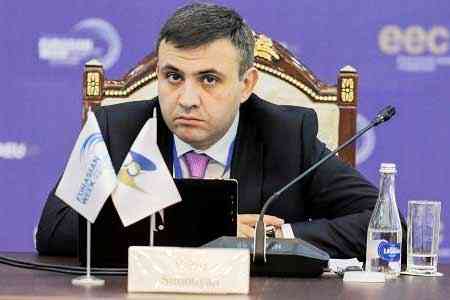
ArmInfo.In a decisive move to accelerate Armenia's transition to a fully digital economy, the Central Bank of Armenia has announced strict new limits on acquiring commissions (fees paid to banks and payment systems for accepting cashless payments - Ed.). Starting March 1, 2026, the fees businesses pay to banks and payment systems for processing non-cash payments will be significantly reduced: 0.5% for ArCa cards and 0.9% for international cards, as stated by Central Bank Chairman Martin Galstyan at a press conference on February 3.
"I believe that from this point on, the dissatisfaction of economic entities on this matter will be resolved. In the second stage, we will analyze the situation to understand whether high commissions were the only reason for businesses to avoid cashless payments or is other factors were at play," he stated.
Speaking about current figures, he noted that only in exceptional cases (for example, if payment is made with an AmEx card) can the commission be 4%, but in general, depending on the card class, the acquiring commission fluctuates between 0.9% and 1.8% on average, which is due to banks' expenses for technologically preparing terminals and cash registers in partner retail chains to accept cashless payments.
Galstyan also noted that acquiring commissions in Armenia are in line with international standards: "However, in our case, prioritizing the promotion of cashless payments, the Central Bank has limited the size of these commissions. As a result, banks' losses will amount to approximately 2 billion drams per year."
According to analytical review "Armenian Banks in the Card Business" ( #32) prepared by ArmInfo Investment Company, as of October 1, 2025, there were over 4.7 million cards in Armenia (with a year-on- year growth of 9.1%). Of these, 770,300 - ArCa cards, over 2.5 million - Visa cards, 1.1 million - Mastercard cards, 148,200 - AmEx cards, and 206,100 - other international cards (primarily MIR cards, with a small number of recently launched UPI cards). The total volume of plastic transactions for the first nine months of 2025 exceeded 5.5 trillion drams (including transactions abroad), with non-cash transactions already accounting for 57%, or 3.2 trillion drams. Moreover, the share of online transactions in non-cash transactions is almost 48%, and when taking transactions abroad into account, it exceeds 70%.