

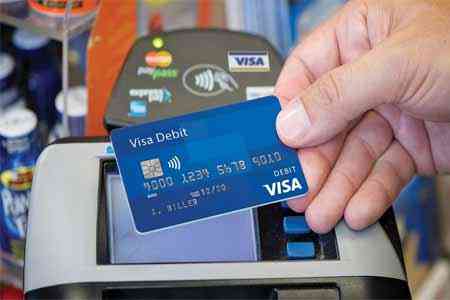
ArmInfo. As of January 1, 2026, Armenian plastic market had over 5 million cards, with the annual growth decreasing from 16.3% to 15.8%. Meanwhile, microprocessing cards with NFC chips experienced a slowdown in growth from 32% to 25%, totaling 4.3 million, which accounts 85% of the total number of cards, according to data from the Central Bank of Armenia.
Visa accounts for the largest share of NFC-enabled microprocessor cards at 53.5% or 2.3 million units, Mastercard follows with 25.6% or 1.1 million units, while local ArCa cards make up 12.3% or 526,200 units. The remaining 8.5% or 363,600 units belong to other international cards. Notably, ArCa microprocessor cards have demonstrated impressive growth for the second year in a row, although the growth rate has slowed from 26 times to 2.2 times, driven by the high chipping activity of local cards and the use of the relatively new ArCa Pay and ArCaQR systems. The growth of leading microprocessor cards, Visa, also slowed, from 25% to 20%. However, it managed to outpace the upward trend not only of Mastercard, whose growth slowed from 15% to 14%, but also of other international cards (including AmEx, Diners Club, MIR, and UPI), whose growth slowed more significantly, from 39% to 16%.
A slowdown in growth was also recorded for virtual cards, from 2.3 times to 44.3%, with 447,000 in circulation (with their share of the total number of cards increasing from 7.2% to 9%). Until mid-2022, these were exclusively Visa cards, but Mastercard cards have also appeared since the third quarter. Moreover, the growth of both virtual Mastercards slowed significantly, from 6.4 times to 2.5 times, and virtual Visa cards, from 2.2 times to 38%. However, Visa remains dominant in terms of numbers, with 400,400 units.
The number of magnetic stripe cards continues to decline at a faster pace, accelerating from 35% to 2 times, reaching 284,700 units by the end of 2025. These are almost entirely local ArCa cards, with Mastercard and other foreign cards remaining insignificant. Visa has discontinued issuing such cards since 2025. After July 1, 2022, when the updated law on cashless payments came into effect, mandating payments exclusively by cashless means, magnetic stripe cards began to be gradually replaced by chip cards. This process was originally planned for 2024, but was later completed in 2025. As a result, the share of magnetic stripe cards in total supply decreased from 42% to 6% between 2020 and 2025, while microprocessor cards with NFC chips increased significantly from 17% to 85%.
The share of hybrid cards has already fallen to 0.4% of the total supply, amounting to 19,003 units, a 1.6- fold year-on-year decline. This was driven by a similarly significant decline in the dominant Visa and Mastercard cards, and a slightly more significant 2-fold decline in local ArCa cards.
Visa cards continue to drive the annual growth in the total number of cards, increasing by 22% year-on- year to 2.7 million, increasing their dominance from 51% to 54%. Mastercard cards increased by 16% in 2025 to 1.1 million, maintaining their share of the total supply at 23%. At the same time, local ArCa cards, having modestly improved their dynamics from a 6.5% decline to a meager 0.3% growth, amounted to 817.6 thousand units with a decrease in share coverage from 19% to 16%. Other foreign cards (including AmEx, Diners Club, MIR, UPI) numbered 363.7 thousand units, with an annual growth of 16%, which maintained their share in the total number at 7%. In the structure of the total number of cards, debit cards continue to dominate - 64% or 3.2 million units, followed by payment cards - 35.4% or 1.8 million units, and the remaining pittance is accounted for by credit cards - 0.6% or 32.4 thousand units. Moreover, the number of debit and payment cards continues to grow - by 14% and 20% per annum, respectively. As for credit cards, their number almost doubled in 2025 (after a 3.4-fold decrease in 2024), but from 2020 to 2025 their number decreased eightfold (from almost 250,000 units). While Visa previously held the lead only in debit and charge cards, and Mastercard was the leader in credit cards, starting in the fourth quarter of 2022, Visa began to displace Mastercard from the leading position in credit cards as well. As a result, by January 1, 2026, there were already over 1.5 million Visa debit cards, 1.2 million Visa charge cards, and 18,800 Visa credit cards.
Note, three Armenian banks, Acba Bank and Converse Bank (since May 2024) and Evocabank (since September 2024), have recently started issuing and servicing UnionPay International (UPI) cards. Moreover, Acba Bank has been servicing UnionPay International cards since October 2019. Regarding HSBC cards, with the completion of the merger between HSBC Bank Armenia and Ardshinbank on November 29, 2024, the foreign bank's "nominated" cards, which were Visa-based, were replaced at Ardshinbank with cards of this system.
Recall, an important technological solution was introduced in 2024- ArCa card payments are accepted online through the EMV 3DS 2.0 EPS Armenian Card domain. This ensures the security of online ArCa card payments for all Armenian banks, regardless of the platform where they are processed. In November 2024, Armenian Card introduced the ArCa Pay instant express payment system. In October 2025, the ArCaQR system was launched, with a total of 11 banks already connected. Also, in October 2025, the Central Bank introduced a requirement to ensure interoperability for payments or transfers using QR codes (a single QR code image installed by banks and payment and settlement organizations at points of sale and/or services). Furthermore, Armenian Card has reached an agreement with international payment systems Mastercard and UPI (a memorandum signed in November 2025) to issue co-branded ArCa cards (scheduled for 2026), with the possibility of their use abroad.