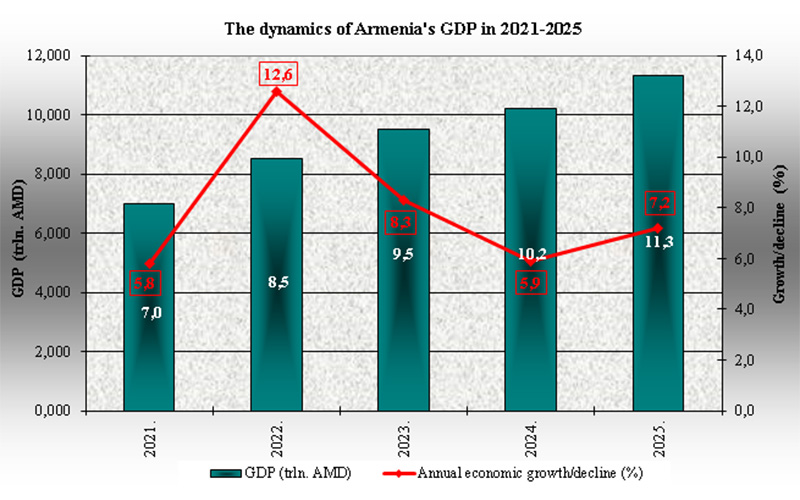


ArmInfo. The World Bank (WB) has improved its GDP growth forecast for Armenia in 2026-2027 to 5.3-5.1% from the previous 4.9-4.7% (compared to an actual acceleration in growth in 2025 from 5.9% to 7.2% - Ed.), as stated in the WB's Europe & Central Asia Economic Update: Industrial Policy, published on April 8.
Meanwhile, in Armenia's neighboring countries, according to the new World Bank forecast, GDP growth in 2026-2027 will be comparatively more modest: in Azerbaijan - 2-1.8% (compared to actual growth of 1.4% in 2025), in Georgia - 5-5.5% (compared to actual growth of 7.5% in 2025), and in Turkey - 2.8-3.7% (compared to actual growth of 3.6% in 2025). For the South Caucasus region (Armenia, Georgia, Azerbaijan), the World Bank forecasts a slowdown in economic growth in 2026 to 3.4% (from 3.9% in 2025), with this rate maintaining in 2027. Overall, the World Bank forecasts economic growth in the Europe and Central Asia (ECA) region to slow to 2.1-2.3% in 2026-2027 (from 2.6% in 2025). Excluding Russia, the slowdown in this region will be less noticeable, to 2.9-3.3% (from 3.6% in 2025).
In Russia, the World Bank forecasts economic growth to slow to a stagnant 0.8-0.7% in 2026-2027 (after decelerating from 4.9% to 1% in 2025). In Belarus, the World Bank also expects economic growth to slow to 1.1-0.8% in 2026-2027 (after decelerating from 4.3% to 1.3% in 2025). Meanwhile, according to the World Bank's forecast, Ukraine's GDP growth will reach 1.2% in 2026 (after slowing from 3.2% to 1.8% in 2025), with a further significant acceleration to 4% in 2027. The report notes: " the region's resilience is being tested again this year amid the ongoing hostilities both in the region and the Middle East, geopolitical tensions, and trade fragmentation. Slowing productivity growth in many countries over the past decade has prompted some policymakers to complement broad structural reforms with industrial policy measures. While certain targeted measures-such as targeted public investment in special economic zones or skills development programs-can help address clearly identified market failures across Europe and Central Asia, industrial policy should be used sparingly and temporarily, as a complement to the institutional reforms needed to boost productivity, create jobs, and foster business dynamism."
"Economic growth in Europe and Central Asia will slow amid mounting risks. Reforms aimed at developing a more dynamic private sector could contribute to job creation and greater economic resilience. This year, economic growth in developing Europe and Central Asia is likely to slow significantly due to the impact of the conflict in the Middle East, geopolitical tensions, and trade fragmentation," the World Bank said in a published report.
Antonella Bassani, World Bank Vice President for the ECA region, noted: "The region's resilience continues to be tested, as several countries rely on imported natural gas, oil, and fertilizer. Efforts will be needed in many countries to overcome the impact of the crisis, with particular attention to targeted support for the most vulnerable. Continued policy reforms aimed at promoting enterprise growth and job creation will also help mitigate the impact of the crisis and strengthen the resilience and dynamism of economies." In Central Asia, growth is expected to slow to an average of 4.9% in 2026-2027 as oil production in Kazakhstan stabilizes. Central Europe is likely to grow by around 2.4% this year, before moderating to 2.3% in 2027, with the decline in consumption partially offset by EU-funded public investment. In the Western Balkans, growth is projected to average 3.1% over the next two years, supported by infrastructure investment and robust services exports. Ukraine's growth is expected to slow to 1.2% in 2026, reflecting continued hostilities, rising energy prices, and fiscal strains. A protracted and more intense conflict in the Middle East remains a key risk, potentially causing a significant disruption to global energy and fertilizer supplies, leading to significantly higher energy and food prices and a further slowdown in regional growth.
A special section of the report, devoted to analyzing how countries can use industrial policy to accelerate economic growth and create jobs, notes that the region's approach would benefit from a clearer definition of priority areas and a focus on measures that foster future competitiveness rather than perpetuating existing structural weaknesses in the economy. For example, currently, nearly two-thirds of all industrial policy measures focus on agriculture and food production, while only 10% support high-tech industries or the production of capital goods.
Ivaylo Izvorski, World Bank Chief Economist for Europe and Central Asia, noted: "To achieve higher productivity and employment growth, ECA countries should focus on implementing ambitious policy reforms to modernize the business environment, stimulate entrepreneurship, and improve the quality of education. The most important type of industrial policy that can help address clearly identified market failures is targeted government support measures, such as the creation of industrial parks or special economic zones. However, the use of industrial policy measures should be restrained and temporary." Where governments do implement industrial policy, the report recommends that it should support new and dynamic private sector firms and innovative ideas, rather than protect incumbents such as state-owned enterprises, and that industrial policy measures should enhance, rather than undermine, competition.
It should be noted that the Central Bank of Armenia, in its March forecast, predicted GDP growth of 7.1- 4.7% for 2026 and then 5.7-5.3% in 2027. According to the IMF forecast updated in December, Armenia's GDP growth will be 5.5% in 2026. Fitch Ratings, in its forecast updated in January, 2026, expects stable prospects for economic growth in Armenia - above 5% in 2026-2027. S&P Global Ratings, in its forecast updated in February of this year, announced a slowdown in Armenia's GDP growth in 2026 to 5.3% and then in 2027 to 4.8%, after which the rate will slightly accelerate to 5% in 2028. The draft state budget of Armenia for 2026 includes GDP growth of 5.4%.
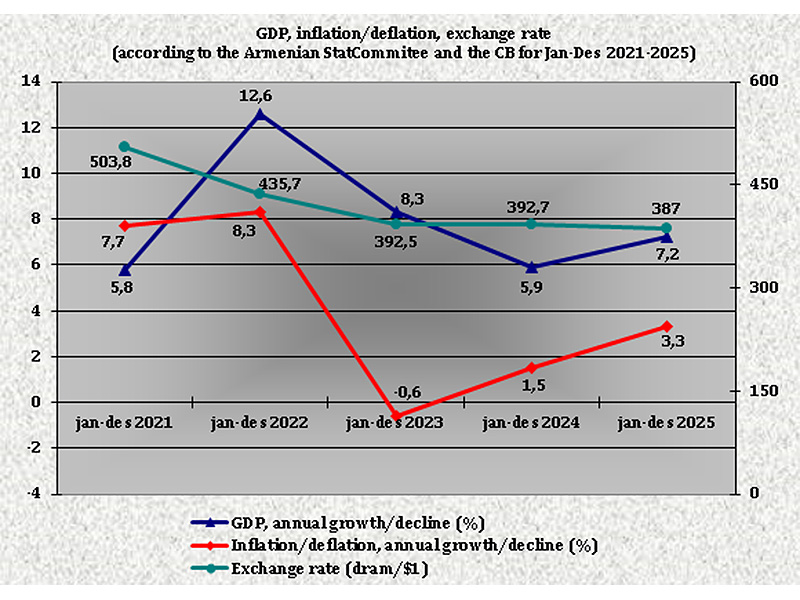
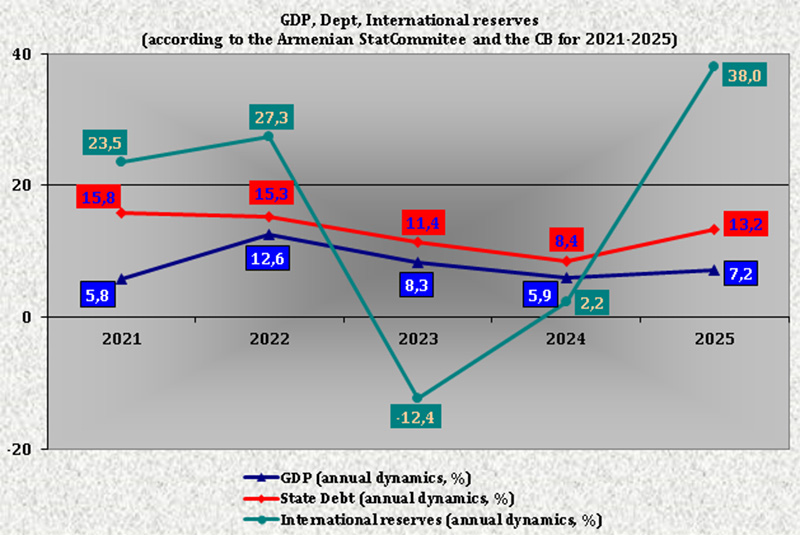
According to the Statistical Committee of the Republic of Armenia, Armenia's GDP growth, after accelerating in 2022 from 5.8% to 12.6%, slowed to 8.3% in 2023 and then to 5.9% in 2024. In 2025, the rate accelerated to 7.2%, reaching AMD 11.318 trillion (over $29.2 billion) in absolute terms. The GDP deflator index also increased from 106.9% to 108% in 2022, decreasing to 103.1% in 2023 and to 101.4% in 2024, but then increased to 103.6% in 2025.