


ArmInfo. Armenia's banking system net profit in the first half of 2026 slowed in year-on-year growth from 17% to 7%, exceeding AMD 214.3 billion or $582.5 million.
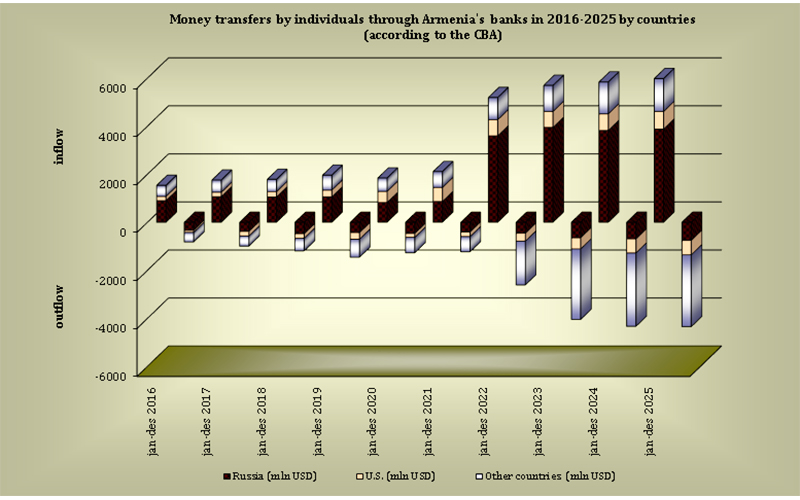
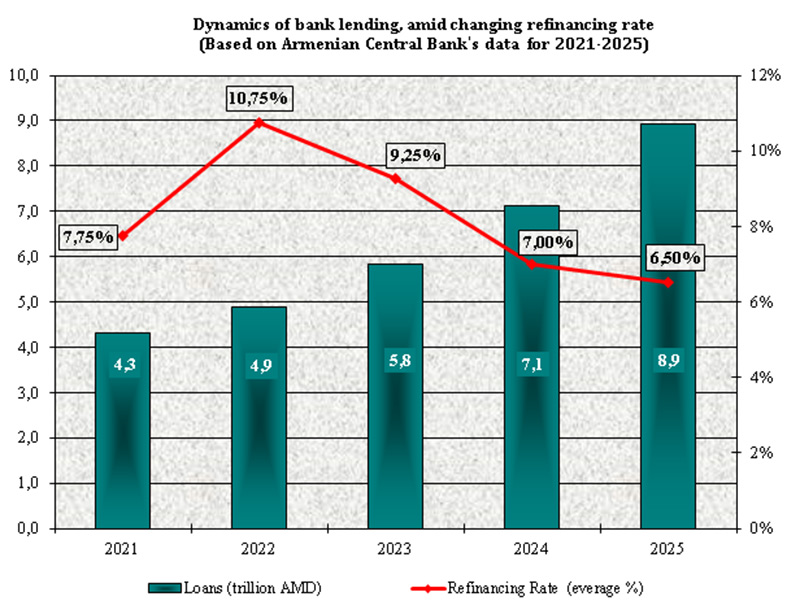
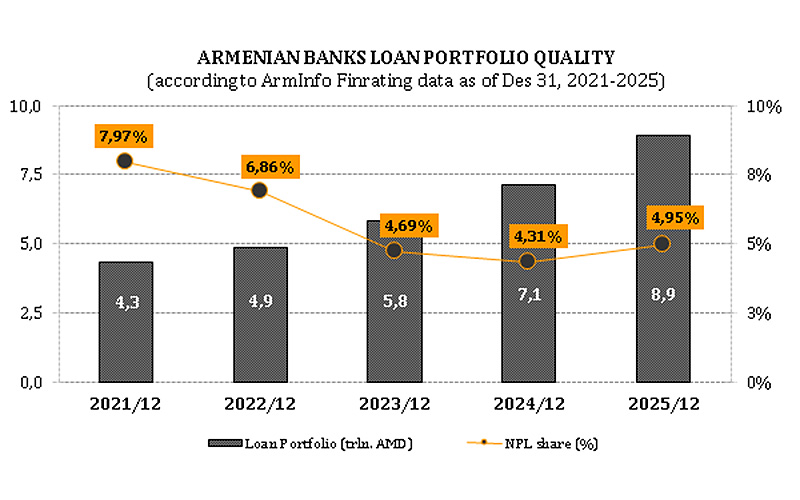
According to the Express Ranking of Armenian Banks as of June 30, 2026, prepared by ArmInfo news agency, net profit growth over the past two years has actually returned to its natural growth rate, supported by lending activity, rather than by temporary factors of short-term impact of non-interest income, as was the case in 2022-2023 during the surge in foreign exchange and card transactions of relocators. In the first half of 2026, the volume of credit investments and other loans reached 8.6 trillion drams ($23.3 billion), with a slight slowdown in growth from 29% to 25%, and an increase in the dominant share of assets from 60% to 62%. This allowed assets to reach more than 13.8 trillion drams ($37.6 billion), maintaining annual growth at 19%. Moreover, in the asset structure, the annual growth of both investments in securities accelerated - from 3% to 10%, and balances in nostro accounts - from 11% to 14%, reaching 2.3 trillion and 2.5 trillion drams ($6.3 billion and $6.7 billion, respectively).
Total liabilities also maintained an annual growth rate of 20%, amounting to 11.6 trillion drams ($31.6 billion). Within their structure, the share of liabilities to clients increased more significantly-from 68.5% to 69.4%-than to banks and other financial institutions-from 25.5% to 25.9%. This is the result of an accelerated annual growth rate of liabilities to clients from 16% to 23%, and a slowdown in the growth of liabilities to banks and other financial institutions from 26% to 20%, amounting to 8.1 trillion and 3.1 trillion drams ($21.9 billion and $8.3 billion), respectively.
As a result, the identical 21% growth in interest income and expenses observed last year slowed to 19% for revenue and accelerated to 26% for expenses, with the volume of expenses in the first half of the year amounting to 601.7 billion and 267.9 billion drams ($1.6 billion and $728.1 million), respectively. A similar change in growth rates is observed for non-interest income and expenses: a slowdown in revenue growth from 19% to 3% was accompanied by an acceleration in expense growth from 15% to 20%, amounting to AMD 183.9 billion and AMD 241.6 billion ($499.8 million and $656.8 million), respectively.
This is explained by the fact that the dominant interest income and expense items-lending and customer liabilities-continued to grow at double-digit rates, although lending saw a slowdown in growth, while customer liabilities, on the contrary, accelerated. A similar change in dynamics is observed for the main items of non-interest income and expense-card transactions and money transfers.
Total capital slowed in year-on-year growth from 19% to 14%, exceeding 2.2 trillion drams ($6.1 billion). In its structure, the share of authorized capital decreased year-on-year from 49% to 46%, while accumulated profit, conversely, increased from 43% to 45%. The absolute values of these amounts amounted to 1.022 trillion drams ($2.8 billion) and 1.003 trillion drams ($2.7 billion), respectively. In particular, accumulated profit slowed in year-on-year growth from 21% to 19%, which was more pronounced in authorized capital - from 17% to 6%. The latter was due to only a few banks increasing their authorized capital: AMIO Bank (by 10.5% in Q1 2026), IDBank (by 43.7% in Q3 2025), Fast Bank (by 10.9% in Q2 2026), Inecobank (by 14.01% in Q4 2025), as well as a reduction in Unibank's authorized capital (by 3.8% in Q2 2026).
The top 5 banks by key balance sheet indicators in the banking sector remained unchanged. In terms of assets, the top five, with a combined asset coverage of over 62%, are represented by Ardshinbank, Ameriabank, Acba Bank, INECOBANK, and AMIO Bank. Ameriabank, Ardshinbank, Acba Bank, INECOBANK, and AMIO Bank also lead in credit investments, with a combined coverage of over 65%. The top 5 banks in terms of securities investments are Ameriabank, Ardshinbank, AMIO Bank, Evocabank, and INECOBANK, accounting for a combined coverage of nearly 57%. In terms of client liabilities, Ardshinbank, Ameriabank, Acba Bank, INECOBANK, and AMIO Bank are in the top 5, accounting for a combined coverage of over 64%. In terms of total capital, Ardshinbank, Ameriabank, Acba Bank, AMIO Bank, and INECOBANK are in the top 5, accounting for a combined coverage of 59%. In terms of net profit for the first half of 2026, Ardshinbank retained the lead, with Ameriabank, Acba Bank, and INECOBANK holding 2nd, 3rd, and 4th positions, and IDBank moving up to 5th. These five banks collectively generate approximately 70% of the sector's profit, with the top two accounting for almost 51%.
With the entry of Fast Bank in November 2022, the number of banks in Armenia reached 18, but later in 2024, with the entry of HSBC, the number of banks dropped again to 17. Thus, in 2024, Ardshinbank acquired HSBC Bank Armenia. With HSBC's exit from Armenia, the country's banking sector now has three subsidiaries of foreign banks, instead of four: VTB (Russia), Mellat (Iran), and Byblos Bank (Lebanon). Furthermore, the presence of international institutional investors, represented by the European Bank for Reconstruction and Development (EBRD) and the Asian Development Bank (ADB), who held stakes in Ameriabank, has also decreased. Specifically, with the addition of Bank of Georgia Group PLC (BOGG, later renamed Lion Finance Group PLC in 2025 after a major rebranding) and JSC Bank of Georgia as Ameriabank shareholders in 2024, with a combined 90% stake, the EBRD's stake was reduced to 10%, and ADB's stake was reduced to zero.
(The AMD/USD exchange rate as of June 30, 2026, was 367.89 drams/$1.)