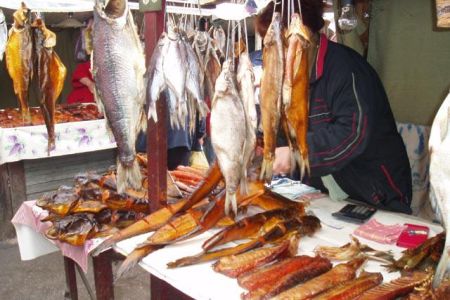
ArmInfo. The Armenian government will provide financial assistance to 135 fish farms in the Ararat and Armavir regions. During its July 30 meeting, the Cabinet approved support measures for fish farming enterprises in these regions.
Presenting the draft, Minister of Economy Gevorg Papoyan noted that these farms are engaged in the production of trout, sturgeon, and caviar. To receive government assistance, all fish farms must be registered as Value Added Tax (VAT) payers. The aid will be provided as a one-time payment, specifically a 20% compensation for feed acquisition expenses, amounting to approximately 900 drams.
The need to adopt this project is driven by the urgent requirement to ensure the financial and operational stability of industrial fish farms operating in the Ararat and Armavir provinces. Due to difficulties, sales challenges, and a shortage of working capital within the fish export sector, economic operators have faced obstacles in maintaining continuous production. This situation threatens to reduce production volumes, lower export potential, lead to job losses, and weaken the sector's competitiveness.
The financial assistance is designed to help fish farmers lower their production costs, enabling them to trade actively on the domestic market and export to international markets. A key condition for receiving the support is that the feed must be purchased from certified companies.
It should be noted that the rationale for the draft resolution emphasizes that Armenia produces approximately 24,000 tons of commercial fish annually, of which approximately 16,000 tons are salmon and 8,000 tons are sturgeon. The main industrial fish farms are concentrated in the Ararat and Armavir regions of the Republic of Armenia, primarily engaged in trout and sturgeon farming and accounting for the majority of fish and fishery product production. Over 40 percent of the annual fish and fishery production was primarily exported to the Russian Federation. However, recently, due to obstacles to the export of fish and fishery products to Russia, economic operators in the sector have encountered serious difficulties in selling their products. The current situation threatens the normal operation of industrial fish farms and may lead to a reduction in production volumes, a disruption to the financial stability of economic operators, job losses, and a decrease in export volumes.
Prime Minister of the Republic of Armenia Nikol Pashinyan, emphasizing the importance of the document, pointed to the need to analyze the situation in individual sectors. Despite the efforts being made, the diversification of export supplies has not yet been fully achieved. However, pursuing diversification means pursuing higher standards and productivity. Pashinyan noted that the annual turnover of fish farms, based on the amount of taxes they pay, amounts to 2.5-3 billion drams. However, if one considers the ineffective management of the artesian waters of the Ararat Valley, the picture becomes simply dire. The prime minister emphasized the need for a closed-loop water supply for these farms.