ArmInfo. Economic activity growth indicators in Armenia remained high in the first half of 2026 amid strong domestic demand. According to Bank analysts, the country's economic growth will reach 6.0% by the end of 2026, amid strong consumer and investment activity. This is stated in the new Macroeconomic Review prepared by the Eurasian Development Bank (EDB).
It is noted that inflation in Armenia has remained above the target range since February. The Central Bank maintained the key interest rate at 6.5% for the first eight months of 2026. Armenia's GDP grew by 6.0% in the first half of 2026. The largest contribution to GDP growth came from the services sector—financial activities, information and communications, as well as construction and mining (increased by 8.8% y-o-y, 11.5% y-o-y, 20.2% y-o-y, and 27.6% y-o-y, respectively).
Consumer spending and investment were the main drivers on the demand side (growth of 5.7% y-o-y and 7.9% y-o-y, respectively). The economy was supported by strong tourism activity (14.8% y/y, or over 1 million visits in the first half of the year) and high remittances (36.0% y/y in January-July).
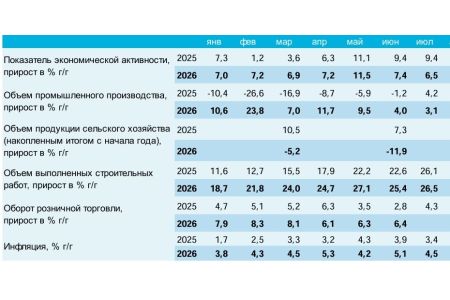
Net exports had a negative impact, as foreign trade in goods and services declined in the first half of the year. Armenia's economy maintained high growth rates in the first seven months of 2026. Economic activity grew by 7.7% y/y in January-July 2026, following 7.9% y/y in January-June. Services made the main contribution (13.2% y/y), while construction (25.0% y/y) and industry (9.5% y/y) also contributed positively. The services sector grew thanks to IT and industries associated with strong tourism activity. Construction was supported by high mortgage lending growth.
Meanwhile, imports increased by 7.7% y/y amid strong domestic demand, while exports declined by 7.9% y/y, including due to external restrictions on food supplies.
Inflation in Armenia amounted to 4.4% y/y in August, after 4.5% y/y the previous month. The main factor was a slowdown in food inflation to 6.4% y/y from 7.4% y/y due to lower prices for certain agricultural products. Non-food price growth amounted to 2.4% y/y from 2.5% y/y, while service inflation accelerated to 2.8% y/y from 1.8% y/y due to accelerated growth in transportation prices. Core inflation remained elevated at 4.5% y/y in July after 4.9% y/y in June, indicating continued strong demand.
At the same time, the appreciation of the dram against the dollar, which has amounted to 4.1% since the beginning of the year, is limiting price pressure. The Bank forecasts consumer price growth of 4.4% y/y by the end of this year. The Central Bank of Armenia kept the refinancing rate at 6.5% at its meeting on August 4. Elevated inflation requires a conservative approach to interest rate reduction.
A reduction in Armenia's risk premium, in turn, suggests a lower rate trajectory. At the same time, inflation has been outside the Central Bank of Armenia's target range (3%+1%) since February 2026. Core inflation dynamics also indicate elevated demand, which remains an argument in favor of raising the refinancing rate in the second half of the year.
From January to July 2026, remittance inflows1 to Armenia increased by 36.0% year-on-year to $4.5 billion. This growth was driven by transfers from the Russian Federation, the United States, and the UAE. Meanwhile, over the same period, remittance outflows increased by 1.3% year-on-year, primarily to the United States.
The budget position has improved. From January to July 2026, the budget was executed with a surplus of 0.3% of GDP (in the same period last year, there was a deficit of 0.5% of GDP). While tax revenues grew by 14.9% year-on-year, expenditures increased by 8.9% year-on-year, enabling a surplus. The government's planned deficit for 2026 is 4.0% of GDP and allows for a moderate acceleration in public spending growth for the remainder of 2026, providing additional support for domestic demand. The foreign trade deficit remained stable: in January-July 2026, it amounted to $3.5 billion, compared to $3.6 billion a year earlier. In January-July, exports decreased by 7.9% year-on-year, while imports increased by 7.7% year-on-year. In the first half of the year, the largest declines were in the exports of precious stones and metals (down 52.6% year-on-year) and food products (down 25% year-on-year). Excluding precious metals trade, exports grew by 17.7% year-on-year, while imports grew by 21.5% year-on-year.
Moody's has improved its outlook on Armenia's sovereign rating from stable to positive, affirming the ratings at Ba3. The revision is driven by reduced geopolitical risks and strengthened growth prospects: in 2026-2027, Moody's estimates GDP will increase by 5-5.5% (below the EDB forecast). International reserves exceeded $6.1 billion in July 2026 (approximately five months of imports of goods and services), reaching a new all-time high.