Arminfo. The Karabakh case reminds us of the risks of accepting a situational outcome as a final solution. The desire to present the desired as reality does not mean that the conflict factor has disappeared. Collective traumas, mutual fears and a sense of historical injustice remain. Therefore, today it is necessary to think not in terms of the superiority achieved, but in terms of the prospect of coexistence. “Putin’s Way” could become a practical tool for increasing trust and replace the logic of division and conflict with the logic of mutual necessity and coordination. This is stated in the academic publication “Putin’s Way”: The Geostrategic and Political-Communicative Significance of a Transport Corridor in the South Caucasus", authored by Vladislav Gasumyanov of the National Research Institute for Communications Development.
The article examines the “Putin’s Way” transport corridor initiative, which envisages restoring communications along the “Russia – Abkhazia – Georgia – Armenia” route. The publication shows that the “Putin’s Way” initiative goes beyond a transport and logistics project and represents one of the models of regional connectivity based on the historically and geographically determined link between Russia and the South Caucasus. It restrains the monopolization of the agenda of unblocking communications by external forces and creates additional conditions for dialogue, the coordination of interests and increasing trust. Despite tense relations, all South Caucasus countries are currently united by an interest in predictable relations and restoring lost trust.
The article emphasizes that transport corridor projects are becoming instruments in the struggle for influence, legitimacy and the interpretation of the region’s future. In this sense, the South Caucasus is becoming not only a transit space but also an arena for competing models of order. One of the most prominent has been the “Trump Route for International Peace and Prosperity” (TRIPP), which declares the objective of creating transport connectivity across Armenian territory and has been included in the agenda of the Armenian-Azerbaijani settlement mediated by the United States.
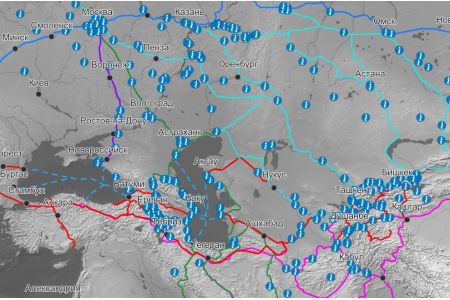
In addition to TRIPP, the following are being promoted in the South Caucasus:
- the Azerbaijani-Turkish “Zangezur Corridor” (the Armenian side avoids the term “corridor”, fearing restrictions on its sovereignty over the route);
- the Armenian “Crossroads of Peace” (which is intended to connect the Black Sea with the Persian Gulf and the Gulf of Oman through Armenian territory);
- the Araz Corridor (a route from the main part of Azerbaijan to Nakhchivan through Iran, bypassing Armenia, with a possible extension to Turkey and the Persian Gulf);
- the Trans-Caspian (Middle, or Middle Corridor), supported by the EU and China (a route from China and Central Asia to Europe via the Caspian Sea, Azerbaijan, Georgia and Turkey, bypassing Russia);
- the “North – South” ITC (its western branch runs along the Russia – Azerbaijan – Iran line and connects with the ports of the Persian Gulf and the Indian Ocean. The project proposes not an east-west but a meridional model of connectivity);
- the “Persian Gulf – Black Sea – Iran, Armenia – Georgia” corridor (the route is intended to connect Iran with Europe via Armenia, Georgia and Black Sea ports);
- the “EU – Azerbaijan – Georgia – Romania – Hungary” Black Sea energy and digital corridor (envisaging the laying of underwater cables to transmit electricity and data from the South Caucasus to Europe, strengthening the region’s integration with the EU).
As the author of the article writes, an analysis of these projects makes it clear that the main competition is unfolding not so much between roads as between the principles governing them – sovereign control, external mediation, exclusive closed access or mutually open communications.
Against this backdrop, initiatives from the Russian side are becoming increasingly relevant, including the “Putin’s Road” initiative, presented and analyzed at the International Conference “Russia and the World: Dialogues – 2026. The New Reality”. This route is intended to connect Russia with Armenia through Abkhazia and Georgia, thereby restoring a direct transport link between Russia and Armenia and providing access to broader South Caucasus and Iranian infrastructure routes. By calling the project “Putin’s Road”, its authors seek to take it beyond the framework of an ordinary transport initiative and demonstrate its geostrategic scale. Moreover, such a name links the project to political authority capable of securing interstate agreements.
The stated initiative caused a media resonance, and some foreign experts began to view it as a counter-narrative aimed at symbolically challenging the American TRIPP initiative and preserving Russia’s presence in the regional architecture of transport connectivity. Respecting different expert positions and not entering into the debate, the publication’s author notes that the “Russia – Abkhazia – Georgia – Armenia” route existed long before TRIPP. Regular service between Sukhumi and Tbilisi opened in 1938, through traffic between Sukhumi and Adler began in 1942, and permanent operation of this section began in 1949.
During the Soviet period, trains ran through Sochi, Gagra and Sukhumi from Moscow to Tbilisi and Yerevan. The unified route fell apart not because it had lost its significance and meaning, but as a result of the collapse of the USSR and the Georgian-Abkhaz war. Therefore, the novelty of the “Putin’s Way” initiative lies not in the geography of the road or in opposition to TRIPP, but in its new political and strategic significance as a transregional corridor creating conditions for an updated type of inter-country communications.
The Russian side has long considered the possibility of restoring rail links with Georgia through Abkhazia as part of the broader task of unblocking transport routes and political communications in the Caucasus. The novelty of the approach, however, lies in the fact that the “Putin’s Way” transport corridor is viewed not only as a transport and economic project, but also as a geostrategic project linked to its political and communicative significance and aimed at positioning Russia’s role in the infrastructure architecture of the South Caucasus as a country capable of creating conditions for greater mutual understanding and interaction among the countries of the region.
The “Putin’s Way” initiative is conceptually aligned with Russia’s strategic interests: 1) preserving cooperation in the near abroad; 2) developing Eurasian transport connectivity; 3) strengthening economic security; 4) countering the external monopolization of the South Caucasus infrastructure agenda.
Against the backdrop of the advancement of the TRIPP project, associated with American participation in unblocking communications between Armenia and Azerbaijan, “Putin’s Way” acts as an alternative Russian model of regional connectivity. While TRIPP is focused primarily on the southern direction and incorporating Armenia into the logic of the “East – West” route, the Russian initiative proposes a “North – South” vector linking Russia, Abkhazia, Georgia and Armenia with a potential connection to Iran. The possible link to the “North – South” corridor and the Iranian route determines the initiative’s particular value. The implementation of the route could strengthen the role of the participating countries in Eurasian transport hubs and provide additional access to Middle Eastern markets. For Russia, this project makes it possible to preserve a direct link with Armenia, strengthen its positions in Abkhazia, remain connected to Georgia’s transit policy and offer an alternative to the Western-Turkish-Azerbaijani logistics configuration. The project demonstrates that communications can be unblocked not only through a Western or Azerbaijani-Turkish format. In this sense, “Putin’s Way” is not merely a route but a way of redefining the balance of power in the South Caucasus. This fully fits both the logic of multi-vector policies adopted by the South Caucasus countries themselves and the logic of forming a multipolar world.
The “Putin’s Way” initiative could potentially contribute to resolving historically accumulated contradictions in the South Caucasus and beyond, as well as soften the conflict legacy of the collapse of the USSR, which determined the development trajectories of Georgia, Armenia and Abkhazia. Georgia’s relations with Abkhazia have been built for decades according to the logic of mutually exclusive sovereignties. From a political and communicative perspective, it should be said that the main problem of the South Caucasus is long-term peace. It freezes contradictions, transferring them into a latent form. The Karabakh case reminds us of the risks of accepting a situational outcome as a final solution. The desire to present the desired as reality does not mean that the conflict factor has disappeared. Collective traumas, mutual fears and a sense of historical injustice remain. Therefore, today, as Gasumyanov believes, it is necessary to think not in terms of the superiority achieved, but in terms of the prospect of coexistence. “Putin’s Way” could become a practical tool for increasing trust and replace the logic of division and conflict with the logic of mutual necessity and coordination. lack of trust.
For Armenia, the “Putin’s Way” initiative could be significant not only as a transport project but also as an instrument for strengthening its foreign-policy agency. At present, Armenia’s land connection with Russia depends to a considerable extent on the route through the “Upper Lars” checkpoint, which regularly entails risks related to seasonal restrictions, snowfalls, avalanches and other natural and climatic factors. Under these conditions, an alternative route through Abkhazia and Georgia could potentially reduce Yerevan’s logistical dependence on a single direction and increase the resilience of its foreign trade links. It should be noted that Armenia’s railway system is already institutionally connected with Russia. Since 2008, it has been under the concession management of a subsidiary of Russian Railways. However, the absence of a through route via Abkhazia and Georgia deprives this link of full transport substance. “Putin’s Way” is significant as an opportunity to restore a fully operational railway connection. For Armenia, which has no access to the sea and is subject to limited regional connectivity, a railway route could reduce the cost of transporting heavy cargo, raw materials, and industrial and agricultural products. In a broader sense, such a transport artery could strengthen Armenia’s role as a link between the Eurasian north and the southern direction, including Iran and a potential connection to the Persian Gulf.
In addition, “Putin’s Way” could become a factor balancing the TRIPP project and reducing Armenia’s dependence on the dynamics of US interests in the South Caucasus. Following the Washington Declaration of August 8, 2025, and the subsequent formalization of the US-Armenia framework program for implementing the Trump Route for International Peace and Prosperity, the southern direction of Armenia’s logistics became part of the American infrastructure agenda. Under these conditions, the emergence of a northern route would allow Yerevan to maintain genuine multi-vector transport policy without becoming exclusively tied to Western-oriented logistics.
For Georgia, the “Putin’s Way” initiative can be viewed as a tool for strengthening the country’s transport and geoeconomic role in the South Caucasus. If the route is implemented in practice, Georgia will have the opportunity to establish itself as one of the region’s key transit hubs, since its territory becomes the connecting link between the “East – West” and “North – South” directions. In such a configuration, Georgia could gain additional economic opportunities through transit revenues, the servicing of cargo and passenger flows, and the development of related infrastructure. The establishment of coordinated mechanisms for facilitating transit through the Abkhaz direction is of particular importance. Once the necessary agreements are reached among all interested parties, mutually acceptable customs, legal and technical procedures could be developed to ensure the safety and predictability of the movement of goods and passengers. This could turn the transport project not only into a source of income but also into an instrument for gradually building transparent economic and legal relations with Abkhazia. The launch of through traffic could stimulate the development of logistics centers, roadside services, the hotel business, public catering, and fueling and repair infrastructure. Tourism is an additional factor, as passengers and motorists traveling from Russia to Armenia could generate a new flow of consumption in Georgia. Finally, control over a key section of the route would strengthen Georgia’s negotiating position.
From the perspective of Abkhazia’s interests, “Putin’s Way” can be viewed as a potential instrument for overcoming transport marginalization and partial international isolation. The potential effect could involve transforming Abkhazia from a dead-end space into a de facto transit section of the “Russia – Georgia – Armenia” route. Abkhazia could receive additional budget revenues from cargo transit, passenger traffic, service infrastructure and related logistics services. An important consequence would be the modernization of transport infrastructure, since restoring through traffic would require the reconstruction of railway sections, roads, service points, and energy and digital infrastructure. This could create new jobs, improve connectivity among Abkhazia’s internal districts and stimulate small-business development. The tourism factor is of particular importance.
Transforming Abkhazia into part of a route connecting Russia, Georgia and Armenia could increase the flow of motorists and railway passengers, including during the off-season. In addition, opening the southern direction would expand access for Abkhaz producers to the markets of Armenia and potentially Iran. Finally, participation in such a project would strengthen Abkhazia’s political agency and its political and communicative significance.
For Russia, “Putin’s Way” is a project aimed at preserving Russia’s role in the processes of unblocking communications in the region. It demonstrates that the United States, Turkey and other players are not the only creators of the region’s future architecture. The project’s economic significance is linked to a possible multiplier effect. Restoring transport communications through Abkhazia and Georgia could stimulate production, employment, trade and the development of border areas. Russian companies could gain new opportunities in the construction and modernization of railway and road infrastructure, logistics, insurance, transport services and exports. In addition, the route could reduce logistics costs for supplying Russian goods to Armenia and potentially expand access to the markets of Iran and the Middle East.