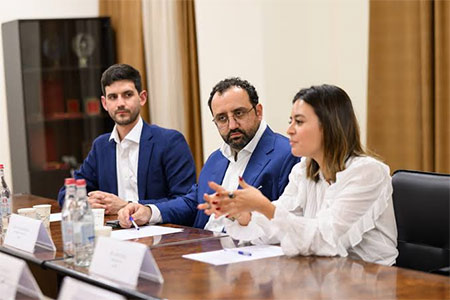



ArmInfo. On October 7, Anna Babajanyan, Deputy Minister of Education, Science, Culture, and Sport of the Republic of Armenia, received a delegation led by Daniel Sanchez, World Bank Social Protection Officer.
According to the press service of the Ministry of Education, Science, Culture, and Sport, the meeting discussed the educational component of the analysis "Barriers to Childcare Access and Their Links to Women's Labor Force Participation in Armenia," which is being implemented with the support of the World Bank.
Anna Babajanyan emphasized the importance of the World Bank's support in implementing education sector reforms in Armenia, noting that numerous important programs are ongoing in partnership with the Bank. Speaking about expanding childcare services for children under two years of age, the Deputy Minister presented ongoing work, noting that relevant groups have been established on a pilot basis in Yerevan, Hrazdan, Gyumri, and Vanadzor.
The issues of increasing the affordability and quality of childcare services, expanding services, licensing institutions, developing the capacity of specialists, and improving data collection and monitoring systems were discussed.
It should be noted that, according to World Bank research, women's participation in the country's labor force is low (approximately 48-56% versus over 70% for men), and one of the key constraints is the unequal burden of caring for children and elderly family members. This is largely due to the shortage of high-quality, geographically close, and affordable crèches and kindergartens, especially in the regions and rural areas (for example, in the Shirak, Tavush, and Armavir regions). Social norms and stereotypes also play a significant role, according to which the traditional perception of women in Armenian society is that they are primarily responsible for running the household and raising children. A significant portion of parents express doubts about the quality of services provided by existing formal childcare institutions, which is why they prefer informal care or completely refuse to return to work. Women with children are more likely to experience career pauses, and the wage gap between men and women in Armenia reaches 25-30% for comparable work.