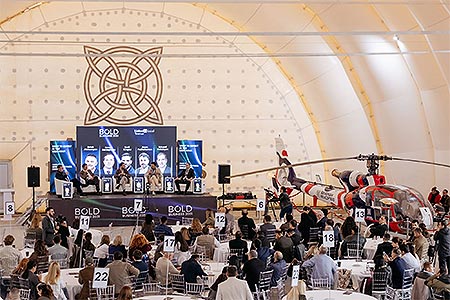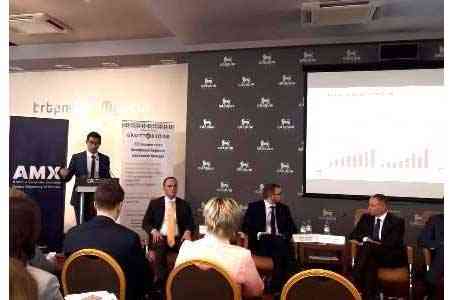
ArmInfo.The CIS Interstate Bank initiates the creation of a mutual trade fund in the national currencies of the EAEU countries and the post-Soviet space. This was discussed at the International Forum "National Currencies of the EAEU Countries: Practical Experience" held in Yerevan today.
The forum participants noted a significant increase in recent years of international trade, including within the framework of the EAEU, nominated in national currencies and the gradual refusal of trading agents from transactions with US dollars and euros. This is due to the desire to circumvent, at times, expensive transaction costs in the context of stabilization of the economic and exchange rate situation in the EAEU countries.
As it was reported at the forum, today in mutual trade between Armenia and Russia, contracts are more often denominated in Russian rubles and, despite the presence of currency risks associated with sanctions problems, 47% of transactions are carried out in Russian rubles. Forum participants noted the need to develop technology for direct quotations of national currencies and procedures for their inexpensive hedging to further stimulate mutual trade.
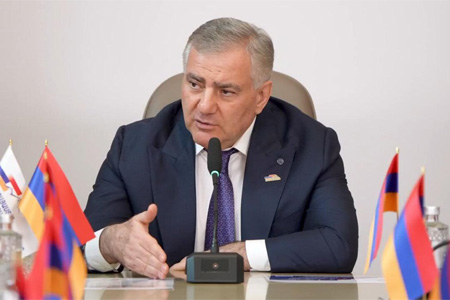
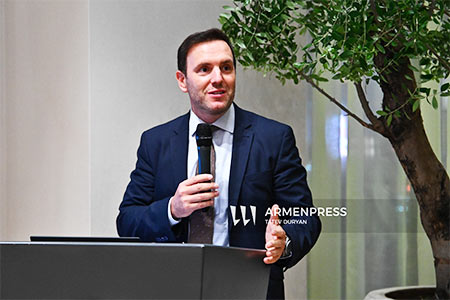
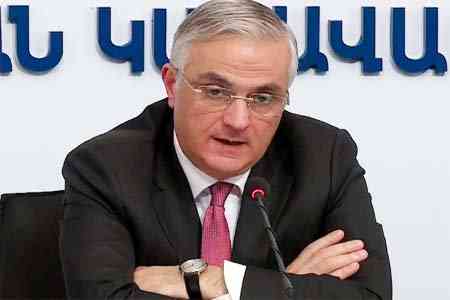
Speaking at the forum, the head of the Armenian representative office the Interstate Bank, former Minister of Economy of Armenia Vahan Melkonyan noted the presence of numerous factors that make it possible to use the Armenian national currency more actively in export-import operations today. According to him, this is facilitated by a well-functioning and stable banking system of Armenia, the exchange rate stability of the Armenian dram, which in turn creates a strong basis for reducing transaction costs and increase the speed of operations. He noted that due to the very fact that the market has matured and is ready to switch to settlements in national currencies, that the Interstate Bank has initiated the creation of such a fund, work with which will allow both financing foreign trade operations without taking on commercial credit risks and making settlements without serious currency risks.
Explaining his statement in an interview with ArmInfo correspondent, Melkonyan noted that the work of exporters through Interstate Bank will allow obtaining trade financing in national currency, especially with the participation of manufacturers not only in purely commercial transactions, but also in large public procurement contracts. "Traditionally, exporters turn to commercial banks for rather expensive loans, not being aware of the availability of other opportunities and tools for trade financing. The tools of the Interstate Bank can quite effectively replace them, while smoothing out the possible credit and currency risks, distributing them among itself and the customers, and acting as Bank - taking on the hedging process. For this, the bank has enough tools, direct access to the exchange platforms of Russia, Armenia and other EAEU countries", Melkonyan emphasized. He noted that the bank shares risks between all participants in the process. <We will protect the deal, protect the reputation of our client, although we may, at the same time, lose. But we are a bank that does not pursue profit-making and our statutory mission is to help promote the economic integration of the EAEU and the CIS. Therefore, for very many products, the bank has zero or almost zero commission rates>, the interlocutor said.
Speaking about the problem of stimulating Armenian exports, Melkonyan expressed the view that, given the geopolitical tensions in the region and the blockade of Armenia, the state could take on partial subsidization of transport costs of exporters, taking not commercial risks, which would be absurd, but political, country ones. He emphasized that it would be justified to implement a project on partial budget financing of export deliveries of goods of Armenian producers, having allocated, for example, 50 million US dollars for these purposes. According to his calculations, if sending a container to Russia costs about 5 thousand US dollars, which is very expensive, and if the government would take on subsidies at least a quarter of this amount, then the country's export potential would jump by 10% immediately, since the cut- off price is related with production efficiency. Manufacturers, especially not very large ones, calculate their costs and often refuse to export their products, and, of course, to invest in the process of expanding production while not having markets.
Meanwhile, according to Alexey Denisov, managing director of international projects at the Russian Export Center, who spoke at the forum, marketing research among the EAEU's foreign trade participants shows that 12% of companies are already actively using national currencies in their operations, and 36% are ready to switch to it. The main problems that exporters point out are the high costs of converting currencies, as well as the habits of making transactions - their own or trading partners. They also indicate the presence of currency risks due to sanctions measures, and expensive hedging instruments. Market participants are also dissatisfied with the limited number of trade finance instruments.
The work of exporters in the Russian market is also limited by the low availability of the Russian ruble in the EAEU countries, including the lack of a loan offer in rubles. He sees the reason for this condition in the underdevelopment of domestic financial markets and in the presence of regulatory restrictions that do not stimulate the use of national currencies. The Interstate Bank is ready to take on many of these problems as a player capable of actively working in the field of conversion operations and hedging, in the market of interbank lending and exchange transactions.
It should be noted that, according to preliminary data of the Statistical Committee of the Republic of Armenia, in 2019 the foreign trade turnover of Armenia amounted to 3,912.9 billion drams ($ 8,154.1 million) with a slowdown in annual growth rates to 10.4% from 16.4% in 2018. In its structure, export volume accelerated annual growth - up to 9.4% from 7.8% in 2018, amounting to 1.267.1 billion drams ($ 2.640.3 million), while annual growth in imports slowed sharply to 10.8% from 21.1% in 2018 , amounting to 2,645.8 billion drams ($ 5,513.8 million).