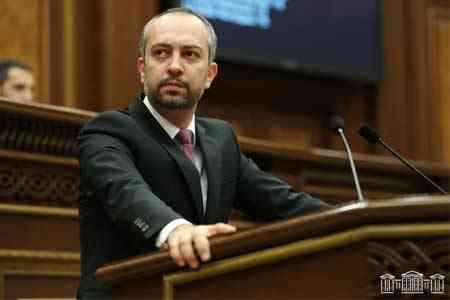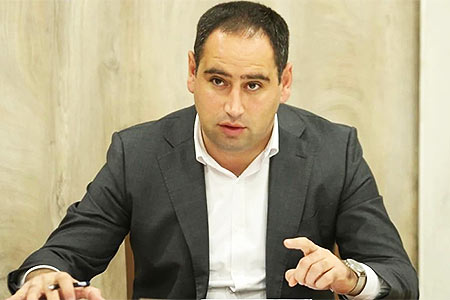


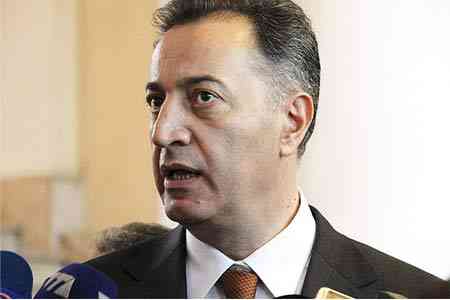
ArmInfo. Former Minister of Economy of Armenia Karen Chshmarityan harshly criticized the concept of creating a Centralized register of bank accounts in the Central Bank of the country.
On his Facebook page, Chshmarityan noted that in fact, with the adoption of this legislative initiative, which was introduced to the Armenian deputies the day before by the Deputy Chairman of the Central Bank of Armenia Nerses Yeritsyan, it will be necessary to about investments in the country's banking system, because they will be zero. According to Chshmarityan, with the adoption of amendments to the law on the Central Bank, a possible outflow of some large investments is not excluded. < I wonder if the private banks of Armenia agree that the full data on the bank accounts of all their clients should be concentrated in the Central Bank?> and what kind of IT specialist will actually judge about the sources of origin of certain amounts and transfer this data on a flash drive.
It should be noted that introducing the draft law on amendments to the RA Law on the Central Bank, Deputy Chairman of the Central Bank of the Republic of Armenia Nerses Yeritsyan noted that the need to introduce such a register comes from the general standards for combating money laundering and terrorist financing. In the future, these changes, according to him, will allow to develop innovative ideas related to the automation of bank accounts of citizens, the introduction of electronic currency, etc. At the same time, Yeritsyan noted that the register does not contain information about the account balance or current movements of funds. He explained that the effectiveness lies in the fact that during various analyses and communications with law enforcement agencies, not all accounts or banks will be questioned, and only those that are the subject of dispute will be selectively collected.
At the same time, Chshmarityan asks how often cases of terrorist financing have been recorded in Armenia, or is the country's banking system so undeveloped that it cannot be trusted? Banks are so well controlled by the Central Bank's supervisory authorities and there is no need for additional control over customer accounts. Chshmarityan is not satisfied with the arguments of the anti-corruption program ...> , allegedly < we are not to blame>. This is called < fighting corruption?> ,- the ex-minister asks the problem and what innovative ideas are we talking about in general? What about the country's financial security and banking secrecy, the independence of private banks, and ensuring their regional competitiveness? Are these useless, clueless functions? And what has become of the ambition to develop the country's financial system as a regional financial center, all of which has been forgotten for the sake of globalism?> - Chshmarityan noted.
Don't the global players know who is financing terrorism? Are there not Turkey and Azerbaijan among them? Who instigates wars, who launders money, who finances? They're all well-known, aren't they from Mars? Or maybe the usual < bitcoin> is not controlled by those who actually sponsor all this, " Chshmarityan noted. The former Economy Minister reminded the initiator of the bill that Armenia is neither stable and developed Malta, the Czech Republic, Spain, nor even France or Austria, and therefore, according to the expert, there is no need to run ahead of the locomotive, < regularly trying to adapt the Rolls-Royce engine to your own dream>.
Meanwhile, according to financial analysts of ArmInfo, the Central Bank's initiative most likely comes from Armenia's obligations under the EU - Armenia Partnership Agreement (CEPA), which has entered into force. It concerns the so-called < fifth AML Directive (Anti-Money Laundering Directive)> The European Union, which entered into force on January 10, 2020 and managed to bring significant changes both in general in measures to prevent attempts at money laundering, and in the market of cryptocurrency services, exchange offices and exchanges, which were based on anonymity and ease of operation. Unfortunately, this directive applies not only to the EU countries, where the requirements for a single register become mandatory, but also to countries that have associative relations with the EU, although in terms of the state of the economies and the investment environment, the associative members are significantly inferior to the EU countries and need additional development incentives, rather than measures that promote the opposite.
Moreover, this initiative may significantly affect the investment attractiveness of Armenia from the third world countries, as well as the Middle East states and Iranian investors. Analysts believe that in the context of a general decline in investment in developing countries in favor of developed countries in the so-called "post-crisis" period, the adoption of EU regulations for such weak countries as Armenia, which are also greatly weakened by the pandemic and war, is not only impractical, but also extremely harmful. The country will also have to start developing the market for securities booms, especially corporate securities, which is still in its infancy and needs to be stimulated by foreign portfolio investors.
And in this regard, according to ArmInfo analysts, the "advanced" EU regulations are completely unnecessary and, to put it mildly, regressive for the economy, since the register of beneficiaries provided for by the AML 5 Directive provides access to it for a fairly wide range of persons, including the police without judicial sanctions, and it concerns not only the financing of terrorism, but also such phenomena as smuggling, bribery, corruption, tax evasion. Analysts also note that by agreeing to the EU's "recommendations" within the framework of the fifth AML directive, Armenia will soon have to agree to the sixth directive, which should enter into force this year. It provides for a significant increase in penalties for questionable cash flows, up to the forced liquidation of companies and serious criminal liability of individuals.