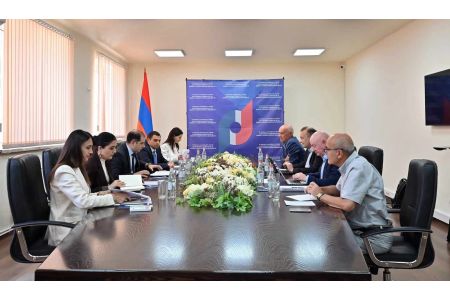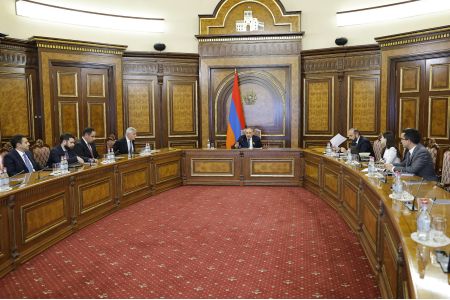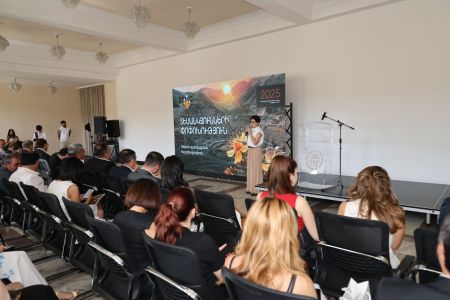


ArmInfo.The interregional Armenian-Russian forum has opened in Armenia yesterday, in the framework of which a business mission of the Russian Export Center (Russian Export Center) will also take place on October 19-20, with the participation of about 150 entrepreneurs.
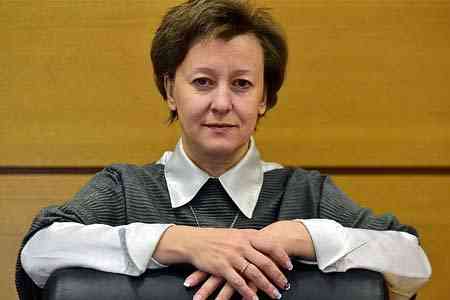
The REC Group includes the Export Insurance Agency of Russia (EXIAR JSC) and Eximbank of Russia JSC. The business mission is represented by Russian manufacturers in the food industry and agricultural products, mechanical engineering, information technology and telecommunications, medicine, diagnostics, pharmaceuticals, building materials, sports goods, and business services. Attached to the start of the mission, ArmInfo prepared an interview with CEO of the Russian Export Center JSC Veronika Nikishina.
- Mrs. Nikishina , what tools does your organization possess to intensify work with Armenia, do you have experience in working with Armenia and what is your assessment of the prospects for cooperation?
- We have experience of working with Armenia on some projects and the most pleasant thing is that we intensively use all our tools in our trade and economic relations with your country. Our toolkit is divided into two large groups - financial and non-financial support measures.
I'll tell about the non-financial ones first. These are usually the tools that we use to help potential exporters find their potential partners. These are various business missions, various consultations, analytics, which first of all allows to determine the target markets and potential projects, and the ways to implement them. And the business mission that we will have on October 20 is just the first very specific point for a more substantive acquaintance of a potential exporter and a potential buyer.
The business mission is multi-sectoral; companies from various sectors participate in it and they were selected considering the specific interests that we receive from Armenia. These are equipment manufacturers, and manufacturers of scientific and technical products, companies that participate in various investment infrastructure projects, have experience in the construction of roads, junctions, railways and various water-technical structures. And therefore, having experience and opportunities, we want to find new potential Armenian partners so that such projects could be implemented in Armenia. Manufacturers of agricultural products, pharmaceuticals, IT, navigation aids are very interested in working with Armenian partners. These are our short-term plans. We hope that the days allotted to the work of the business mission will be as productive as possible, including primarily through numerous B2B meetings.
- What financial instruments do you own, and how can they help integration projects between Armenia and Russia?
- When companies are already approaching project maturity, they also need financial support. There are 2 groups of instruments in our arsenal. These are credit and guarantee support from Eximbank of Russia and export credit insurance from EXIAR. Sometimes we lend and insure from above, and sometimes, if the lending is somewhere else, we simply insure the loans that the buyer takes from other banks. Sometimes, when structuring the financial part of the project, we help to choose a bank ourselves, and then we get interbank financing with our insurance.
- What statistics do you have for Armenia? What has already been done?
- I can start with the figures for the last year. 18 exporters received solid insurance products for Armenia. These were short-term receivables, but the most demanded financial product is export insurance. The statistics are interesting: 56% of exporters accounted for mechanical engineering, 20% for the metallurgical industry, 12% for the agro-industrial complex.
And this year, for the first 8 months, we already have agreements with 15 exporters in Armenia. They have already signed insurance contracts, including for short-term receivables, deferred payment insurance for SME clients, and insurance for a customer's loan. This is in quantitative terms, but if we consider the volume of exports supported by us, these 15 export transactions give a volume three times exceeding the one for the entire last year. That is the projects are getting bigger. Therefore, we have a reasonable hope that the potential that exists will be really in demand.
We already have a so-called flagship project with Armenia - the supply of 27 passenger cars to the SCR. This is a project funded purely by us. ROSEKSIMBANK gave a loan to the Eurasian Development Bank (EDB) for this deal and provided insurance for the supplies.
So, we have some practice of working with Armenia, but we want to scale this work. Now we really want to offer cars for the Yerevan metro, since we have experience in structuring and financing such transactions. We really want to be partners in the construction of new lines of the Yerevan metro. Now, within the framework of the tender for their design, we very much hope that one of the Russian companies with excellent experience in this area will become the winner, and their work will receive full support from us, including financial one.
- Are these mainly infrastructure projects?
Yes, they also include projects in the field of energy, especially in the field of renewable energy. There are serious companies in Russia that produce high-tech equipment for renewable energy generation. They are able to implement both EPC (Engineering, Procurement and Construction) and EPCM (Engineering, Procurement, Construction, Management) contracts. Thus, last year we had a project with Kazakhstan, which in our opinion, is worth replicating. It also received funding through the Eurasian Development Bank. We are talking about the supply of solar thermal power plants. These are small regional thermal power plants that heat both the population and provide energy to local producers. It seems to me that in such a sunny climate as Armenia, it is a sin not to use solar energy extensively, and the consumers can also be greenhouses in the construction of which we would also like to participate. Thus, our experience in implementing both large infrastructural and small fast-payback projects allows us to offer our Armenian colleagues the entire range of our tools, designed for the specific needs of the consumer. We are successfully implementing such transactions in various CIS countries. Over the past year and a half, we have implemented a lot of such projects and the key to success is simply the interest of a partner both on the part of the state and on the part of business. And here we see great potential and we need the will and desire of a partner.
- Have all 18 projects with Armenia been successful? Did you have any problems with payment or paying capacity?
No, there were no problems. All transactions have been successful. We are well financially strengthened by the state, so that we, as a development institution, would be mobile and effective. Therefore, we are ready to use all our tools very flexibly.
- How many of the 18 "Armenian" projects are exclusively state-owned and how many are related to public- private partnerships?
- You know, almost all of them are actually private-state. And they are all commercial ones, since the commercial component prevails in them. But where necessary, they are accompanied by a guarantee from the state. But, in principle, since the projects are not very large, we can afford to finance them without state support. Of course, if the project is large, for example, the construction of new metro lines, of course, we will need the state guarantees of the Republic of Armenia for financial comfort. But these things are absolutely solvable, and the main thing is that these are some rules of the game that must be observed in order for the project to be implemented faster. But the risks we forecast for them are quite moderate and low.
- Deindustrialization has hit our countries hard. We began to lag behind technologically, and it is time to catch up within the framework of integration processes: One of the solutions is the implementation of specific industrial integration projects based on modern technologies, up to the widespread use of the artificial intelligence. It can be instrument making, machine tool building, radio engineering industry, information technologies. Are we capable of starting such a catch-up marathon? Yes, I think it is possible. And we have such projects, though not with Armenia yet. At the end of last year we were at the opening of the Tashkent Metallurgical Plant. This is a factory built from scratch based on the most modern technologies. The loan was provided by ROSEKSIMBANK, insurance from EXIAR, Russian equipment was being supplied, although European equipment was also used there. The plant is already in operation, it has been launched.
Russian metal goes there as a raw material. This is a good cooperation project. Now we work with the leadership of Uzbekistan and maintain a constant dialogue. You know, when there is a request for infrastructure, we sit down and discuss with our exporters and investors from the partner's side for investments, structure the deal and really achieve success. Likewise, we expect Armenia to show interest.. We have experience, we seriously rethink all the omissions that we have had on past projects, in no way repeating them. Therefore, we are very interested in activating such an industrial cooperative cooperation with Armenia.