ArmInfo. At the end of October, Yerevan hosted the annual but already traditional event in the country's IT industry - DigiTec Expo2021. This time the event took place in the exhibition area of the Karen Demirchyan Sports and Concert Complex.
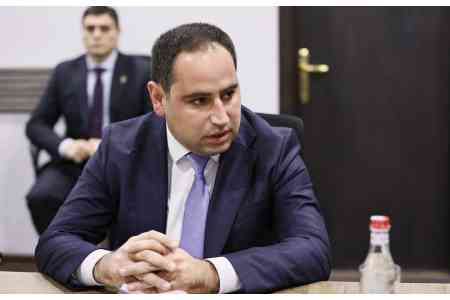
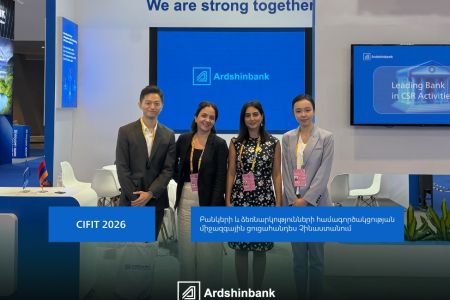
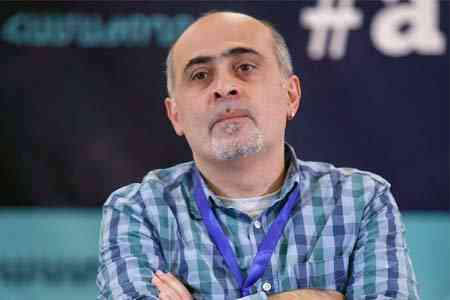
More than 100 companies gathered in the area of 1.4 thousand square meters, presenting their latest technological achievements and developments. The scale of the event could not but impress. It should be noted that in addition to IT companies, the representatives of the Armenian banking system, telecommunications, the national postal operator, etc also presented their digital solutions, which indicates the general trend of digitalization in the country. On the sidelines of the exhibition, ArmInfo correspondent managed to talk about the situation in the domestic IT industry, about the problems and prospects of Armenia as a country with a technological future, and about many other things with well-known expert in the IT sector and in the field of information security Samvel Martirosyan.
- Mr. Martirosyan, DigiTec has been held in Armenia for 15 years already, where domestic developers present their latest developments in the field of IT, high technologies, engineering, and other fields. Much has been said about the high human capital in our country as a great advantage. But against this background, it cannot but be mentioned the tragic events of last fall, when Armenia faced a new type of war, in which the technologies that we lacked practically won the war...
- The point is not that we do not have any developments. The war demonstrated one obvious truth - we do not have management at all levels, and on top of that, there is no strategic vision and real awareness of the situation. Even the mobilization was carried out in such a way that those specialists who could help the army and security were mobilized into motorized rifle troops. That is, there was an incorrect distribution of human resources. Let's speak to the point! Criminal distribution of human resources!
IT companies, in addition to helping as much as they could, also supported the economy. It must be borne in mind that it is impossible to mobilize the entire population. The state can mobilize about 10% of it. This is a well-known fact.
After all, if you start to mobilize everyone, the economy may collapse, the rear will collapse, and as a result, the army will not be able to hold out. While the part of the population that is not only unable to help wage a new kind of war, but also supports your economy was mobilized.
- That is, the problem is not the lack of human resources, specialists who were supposed to work on the technological strengthening of the country?
- Here we also have problems. Because the county's human resource should receive offers. That is, we come to the conclusion that there should be a more serious integration of the military-industrial complex and other sectors, and the economy, accordingly, should be science-intensive. And this indicates the need to provide serious support to science. Adding some extra 20-30 million drams, one cannot say that you are developing science and education. These two areas should be prioritized in the straight sense of the word. Except for fiscal injections, this still has to be at the level of propaganda. And in our country this is given a secondary role.
If we develop exclusively as a consumer society, which is ready only to consume and is not capable of producing anything and it is not only about production capacities, but also culture, then naturally, in a critical situation we become unable to withstand challenges. It should also be noted that there is no serious understanding of what we have in the high-tech sector. Many companies came themselves and offered help. And it was obvious that there was no understanding of the landscape.
- What is the reason for that?
- The problem of the Armenian IT industry is that it has been developing as outsourcing for a very long time. We carried out orders for foreign countries. And as a result, there was a separation from society, from the state. Armenia has practically not used the resources of its own IT industry for itself.
- Official data also indicate this. Traditionally, the main share of the IT sector's revenue falls on services (86.2%, ed. note), rather than on its own production. The share of our own production is quite scanty (0.8%, ed. note).
- The problem is that very often foreign companies win in various tenders, although the issue is not that it is impossible to have your own production. Secondly, in principle, our country has begun to follow the path of digitalization literally recently. Yes, there were many local projects, but by and large digitalization is something new for us. But in general, we can say that over the past 5-6 years we have seen qualitative and quantitative changes. First, we started not only outsourcing but also producing something. We have large companies.
Over the past couple of years, we have seen a new qualitative leap. Investments have also started to flow in the Armenian IT sector. That is, now we are already becoming a country of the international level. So far in local segments, but it is obvious that some kind of barrier has already been overcome. And finally, we have a digital transformation going on inside us, which is most visible now in the financial sector in the field of fintech.
We, however, are lagging very seriously behind many countries. But at least we already see that there is some kind of breakthrough forward. This means that finally the IT industry turns towards its own country. And production is also shifted to serving the domestic market.
- And what has changed?
- The psychology has changed, fortunately. There was a possibility, that we will follow a negative scenario, becoming a country of completely outsourced services. But this did not happen thanks to a few very large startups firstly that helped others psychologically overcome this barrier. For example Piбsart. Suddenly, people realized that they had to work not only for the local market and an external buyer, but also try to build their own products, and at the global level. Because the local market is too small. And now there is a sharp psychological turn in the good sense of the word. We are entering the international market, to a broader outlook. If at the first stage the IT industry began to develop, because many Armenians invested and built branches of their companies, then the second stage of development is that many of them are now transferring their businesses from abroad to Armenia, moving here, for example, Smart Click, Krisp. Of course, there is also an outflow, but it is not so high in the IT sector.
- Walking through the pavilions at DigiTec Expo, could you say that we really have something to show in terms of our own production?
We have a lot of interesting things. And, fortunately, we learned how to sell it. Before that, developments appeared and disappeared very quickly, because people did not know how to raise capital. This has always been a problem. Integration on a global scale has now begun to take place. I think that in 2 years we will see a serious qualitative leap.
- And in conclusion I would like to ask you in what direction, in your opinion, we are stronger and can have our say on at the international level?
- Our strength should be in versatility. We are a small country, and if we start focusing on only one thing, very quickly those other directions will disappear, and if something in the world suddenly switches, we will simply lose flexibility. But in terms of breakthrough capabilities, I would call artificial intelligence (AI), and everything interconnected with it. Because this is a new sector, and Armenia has every chance of becoming a serious center, on the condition that it moves forward actively, together with the state. Because in this direction, even being a small country, have a real chance of breakthrough growth and gaining some dominant positions, with your small physical coverage.
- Thank you for the conversation.