

ArmInfo. The Armenian government has revealed the main directions of tax policy for the next three years. The document entitled "Tax Revenue Management Program for 2022-2025", signed by Armenian Prime Minister Nikol Pashinyan, allows us to assess the scale of the expected changes.
As stated in the preface to the document, referring to the government's program of activities for 2021-2026, tax policy should contribute to the competitiveness of the business environment and ensure tax revenues determined by the state budget. , the document says.
According to the authors of the document, in order to increase tax revenues, it will be necessary to:
- improving tax administration and, as a result, improving tax compliance,
- expansion of tax bases, including by reducing certain benefits,
- increase in the tax burden on certain tax rates or certain types of activities;
- revision (increase or decrease) of the number of taxes or obligatory payments.
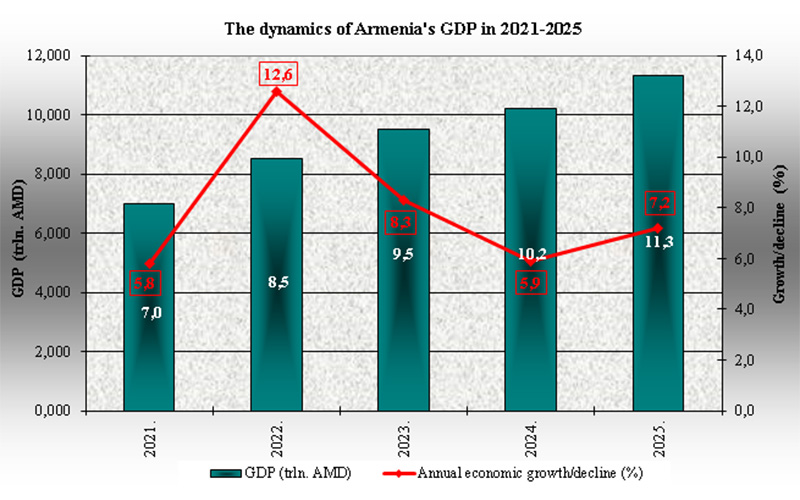
At the same time, it is emphasized that taxes, which are received less due to the benefits defined by tax legislation, which are also known as tax expenditures, are estimated at about 503 billion drams or 6.4% of GDP for 2022.
Value added tax
VAT has the largest weight in tax revenues. In 2021, VAT accounted for 35% of tax revenue. Over the past 10 years, it provided 34-40% of budget revenues.
The standard rate of 20% has not changed since the introduction of VAT. The reduced VAT rate has never been applied. According to the financial authorities of Armenia, VAT is the factor with the greatest potential for increasing tax revenues, since a 1 percentage point increase in the rate could increase tax revenues by 28 billion drams.
At the same time, the authors of the document admit that the standard rate of VAT in Armenia, 20%, is the highest in the EAEU and, in addition to the Republic of Armenia, is applied in Russia and Belarus (in the Russian Federation and Belarus, reduced rates are also set - 10%).
During the program period, the standard VAT rate will remain unchanged. At the same time, it is noted that in order to mitigate competitive inequality (the y-o-y turnover of most agricultural producers does not exceed the threshold set for being considered a VAT payer of 115 million drams per year, in connection with which they do not pay VAT), it is planned to discuss the issue of establishing a reduced VAT rates of 10% exclusively for transactions related to the sale of a very narrow range of locally produced agricultural products. At the same time, it is planned to discuss the issue of creating the possibility of a VAT offset for the buyer in the amount of 3% of the transaction amount in the event that goods are supplied to VAT payers by agricultural producers that are not recognized as VAT payers.
The authors of the program took into account the international practice of applying VAT in the field of education and healthcare in terms of VAT privileges, the study of which indicates that these services are exempt from VAT. Thus, during the period of the program there will be no revision of preferences for education and medical care. However, the taxation of certain medical services (e.g. aesthetic services, etc.) may be subject to discussion, taking into account possible administrative and other related issues.
The same international practice states that the financial services sector is, in most cases, exempt from VAT. However, the financial authorities tend to discuss this issue in more detail.
In international practice, gambling activities are not subject to VAT. However, as noted, this is due to the fact that alternative methods of taxation are used, which should guarantee a higher tax burden than VAT (and ensure that income from this sector is sufficiently taxed. Accordingly, a proposal is being prepared to increase the tax burden on gambling activities.
The financial authorities are ready to offer an alternative solution for the taxation of the jewelry sector. The willingness to further reduce the list of taxable goods paid at the border is also mentioned.
Income tax
Income tax revenues provided 26-30% of all tax revenues over the past 10 years. During the same period, income tax payments generated revenues of 5.5-6.7% of GDP. In 2021, income tax revenues amounted to 6.1% of GDP. In addition, social payments amounted to 0.6% of GDP. , the document says.
General declaration of incomes
As the authors of the document note, the next important area of income tax reform will be associated with the introduction of a system of general declaration of incomes. It is assumed that the introduction of the system will not have a significant impact on budget revenues during the first few years. It is also possible that in the short term this will be accompanied by an increase in expenditures related to social compensations (social loans) in the state budget. At the same time, according to the plan of the financial authorities, the consolidation of information on the income and expenses of citizens in the declaration system will improve the targeting and efficiency of the state's spending policy. During the period of the program, a phased introduction of the income declaration system will be implemented, and it will be completed within two to three years. At the same time, in order to form a culture of declaring income and improve the efficiency of the system, it is planned to discuss the possibilities of facilitating the provision of various public services to persons who filed a declaration.
Profit tax
In 2021, income from profit tax amounted to about 159 billion drams, or 10% of tax revenues. Over the past 10 years, profit tax provided 9.5-16% of tax revenues of the state budget. The rate of this type of tax is 18%. There will be no increase in profit tax rates during the program. , the program says.
Excise tax
In 2021, it provided about 7% of the tax revenues of the state budget. Over the past 10 years, excise revenues have ranged from 4.5 to 9.5% of tax revenues. Tobacco products, alcoholic beverages and petroleum products are subject to excise tax. The list of goods subject to excises corresponds to the approaches used in international practice. The composition of taxable goods will not change significantly during the period of the program. Excise rates are set in AMD at fixed rates. In some cases, the law establishes a schedule for raising rates (tobacco products, alcoholic beverages), and in other cases, indexation coefficients to base rates (2020 is considered the base year). Accordingly, new rates will be established and put into effect in order to ensure a progressive increase in the excise component in the price of excisable goods. However, according to the financial authorities, as a result of the changes, new revenues from this type of tax cannot significantly increase the weight of the excise tax in tax revenues and become decisive in increasing tax revenues in the coming years.
Taxation of microenterprises
Despite the very short - two-year period of the system, the number of micro-entrepreneurship entities reached 50 thousand with a turnover of 200 billion drams in 2021.
"The rules applicable to microenterprise entities will be revised so that the "preferential environment" of taxation does not undermine the tax base of other types of taxes," the document says.
Turnover tax
State budget revenues from turnover tax in 2021 amounted to 32 billion drams, which is 2% of tax revenues.
During the period of the program, it is planned to abolish the application of the turnover tax system. In this case, it is planned to calculate VAT based on the data of the system serviced by the State Revenue Committee, and to replace the profit tax with a tax on distributed profits, imposing an administrative burden on the tax authority.
Royalty
In 2021, state budget revenues from royalties amounted to 52.6 billion drams, or 3.3% of tax revenues. However, if we also take into account that last year 24.6 billion drams were received in the budget in the form of state duties of the same nature, then their amount will be 77.2 billion drams or 4.5%.
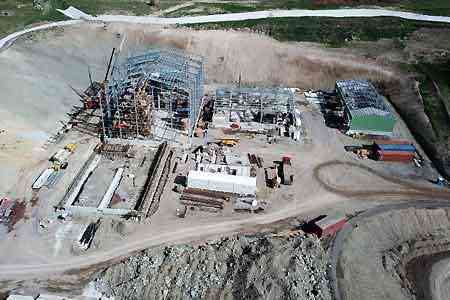
It is noted that it is necessary to revise the procedure for determining royalties for metal concentrates. In this regard, the royalty rate will be revised from January 1, 2023. Under the new system, the current state export duty will be replaced by a third component of royalty, which will depend on the amount of profits above the 15 percent revenue threshold. Accordingly, in conditions of high market prices, additional royalties will be paid from such profits, and in the case of low prices, only the first component of the royalty or also the second one will be paid.
State duty
During the period of the program, the principles for the application of state duties will be revised - the application of a tax nature will be allocated within the framework of the relevant regulations. The amount of the state fee for services in the exercise of state powers will be as close as possible to the actual costs incurred by the state.