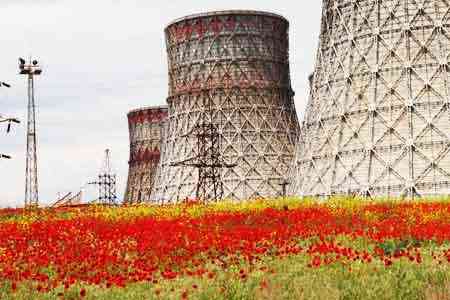
ArmInfo.A new NPP construction project continues to be talked about in Armenia. No one doubts Armenia needs a new nuclear-powers plant (NPP), but its capacity is being questioned. According to the preliminary data, Armenia's authorities are inclined to the construction of an NPP with a capacity of 1,200MW, with experts raising objections. According to them, Armenia needs an NPP with a capacity of 500MW.
ArmInfo is presenting to opinions on the project.
In an interview with ArmInfo, Gera Sevikyan, Advisor to the Director General of the Armenian NPP, said that no final decision on a new NPP construction has yet been made.
"We are expecting the Russian side to present three options - 1,000 MW, 1,200MW and 1,200MW VVER- TOI [WWER-TOI]. A final decision will be made only after we examine the options," he said. The Armenian side is inclined to the 1,200MW WWER-TOI as Armenian experts are well-acquainted with this type of nuclear piles. It will not require new documents or amendments to the relevant laws.
With the current economic growth rates and new companies opening in Armenia, the country could have energy deficit. Moreover, electric vehicles expected to be put into operation by 2030 will require an additional 4.5bln kwh of electric energy, which is nearly as much as generated by the second nuclear pile of the Armenian NPP.
As regards the economic component of the project, the construction of a 600MW NPP will require investments equal to 80% of the investments needed for the construction of a 1,200MW plant. Also, a 1,200MW plant can be operated for 60 years, with a 40-year-long extension period. That is such a plant could operate for 100 years, which is not the case with a 600MW plant. "By 2035, Armenia's energy consumption is expected to increase by 33%, which should be considered in the context of electric energy export," Mr Sevikyan said. The NPP-generated electric power has the lowest production cost in Armenia now, he added.
Armenia's energy development strategy provides for the construction of a new NPP.
"It is common knowledge that Armenia cannot live without nuclear power engineering. The construction of a new NPP could require 10 or 11 years and if the currently operating nuclear pile is stopped during the construction, it would lead to the loss of the available potential, including specialists. This is the reason for the task to extend the operation of the currently operating NPP until 2036," Mr Sevikyan said.
Armenia is cooperating with Rosatom in preparing the feasibility report for the project. If Armenia's government approves the report, practical work will get under way.
However, Armenia's former minister of energy, member of the Scientific and Technical Council, Eduard Arzumanyan disagrees with Mr Sevikyan. According to him, Armenia's intention to construct a 1,200MW NPP is wrong as it is a direct threat to the country's energy security.
According to him, at present Armenia's energy-generation sector's peak performance is 1,200MW.
"So Armenia will have to operate only one NPP, which is unacceptable," he said. The expert has doubts that during the NPP construction period Armenia's economy could double or even triple, which was claimed by Armenia's Minister of Territorial Administration and Infrastructure Gnel Sanosyan. Also, what will be the fate of the electric energy generated by renewable energy-generating facilities, whose capacity, according to the energy development strategy, could be brought up to 1,000MW by 2030.
The construction could require 8 to 10 years and $5-6bln. Hardly anyone could grants such funds, so loans will have to be attracted to be repaid later. In this context, Minister Sanosyan's statements that the new NPP will generate inexpensive electric energy sound unconvincing, as any investments require return, which, in turn, will cause a rise in the tariffs for both the NPP and consumers. The tariff at the currently operating NPP is AMD 12 per 1kwh, but it could be raised 2-3-fold after a new NPP has been constructed.
Mr Arzumanyan is also critical of Minister Sanosyan's statement that the energy to be generated by the new NPP could be exported to Georgia and Iran by means of the 400-kw lines Iran-Armenia and Armenia- Georgia.
"Both the high-voltage lines are expected to be ready by mid-2025. However, the issue of who will import Armenian electric energy will remain unsettled, as by 2026 Iran will construct two new nuclear piles at the Bushehr NPP thereby eliminating its electric energy deficit. The same can be said about Turkey, where, with Russian experts' participation, the Akkuyu Nuclear Power Plant will be put into operation, with four nuclear piles with a capacity of 1,200MW each. Moreover, South Koreans will construct the Sinop NPP in Turkey, at Sinop on the Black Sea, which will fully meet Turkey's energy needs," the expert said.
Georgia will not import more expensive electric energy from Armenia, Mr Arzumanyan said. He proposes considering the construction of a 600MW nuclear pile.
"Russia is not operating such nuclear piles, but China and Canada are. And the Armenian energy sector development strategy of 2016 gave priority to Chinese and Canadian piles," Mr Arzumanyan said.
He addressed a letter to Armenia's Premier Nikol Pashinyan proposing formation of a work group of atomic energy experts, but has never received an answer.