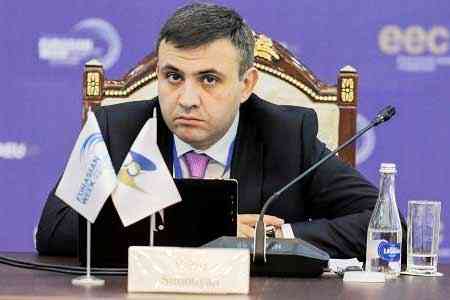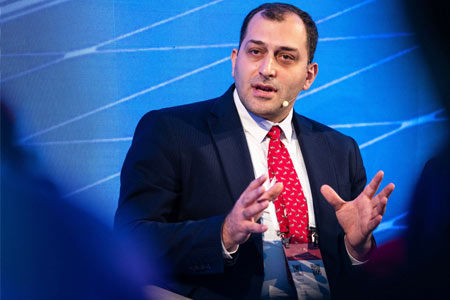
ArmInfo. The legislative changes initiated by the State Revenue Committee (SRC) of Armenia, allowing the tax authority to request from the taxpayer a bank statement on transactions without a court decision, will lead to the establishment of an "economic dictatorship" in Armenia, based not on the rule of law, but on the principles of permissiveness of the tax authorities . Eduard Badalyan, an Expert at the Citizen, Taxpayer, Business Rights Protection NGO shared this point of view in a conversation with an ArmInfo correspondent.
SRC is not CSS (KGB)
The expert assures that the current legislation already provides the State Revenue Committee (SRC) with the opportunity to receive bank statements within the framework of tax control and if justifiably necessary. So what motivated the tax authorities, isn't it the desire to move smoothly from control to total dictatorship?
The tax legal relations expert considers references to the fact that obtaining court permission requires additional time and extra effort, as well as the lack of opportunities to apply appropriate penalties to non- law-abiding taxpayers, as stated in the rationale for the project.
"It is important to consider that you have to obtain a bank statement through the court only if the taxpayer refuses to provide it in response to a legal request from a State Revenue Committee employee. We all understand that such cases are rare. It turns out that the SRC strives to obtain the desired information easily and effortlessly. However, to better understand the validity of this thesis, we must be provided with statistical data indicating that the need for a court decision "ruins" the work of tax officials. It is possible that there are dozens of such cases, at most a hundred, but what is their share among 100 thousand taxpayers? It is trivial. Therefore, this figure is not substantiated. This means that the real goal of the SRC is completely different," he noted.
Badalyan emphasized that, among other things, the project could cause alarm for the simple reason that <today's SRC> has a long way to go before it is ready to manage such a large volume of bank secrecy. Just a few days ago, the interlocutor recalled, information appeared on social networks that an official of the State Revenue Committee, at the same time from a senior level, used a personal email when communicating with a citizen on a single platform of electronic requests e-request. "Unfortunately, such cases are not rare, and it is dangerous," the expert notes.
At the same time, as practice shows, even today a number of SRC employees in certain cases try, perhaps even "for good purposes" to ensure appropriate tax collection indicators, to bypass at any cost the requirements of the current legislation governing cases of inspections and a number of activities. "Under these conditions, it is very dangerous to provide the tax officer with another tool of pressure - to entrust the banking secrets of citizens and taxpayers. This may increase corruption risks. With this initiative, we also put an end to the institution of bank secrecy, which as of today is already very vulnerable in Armenia," the expert believes.
The expert recalls that when introducing a system of universal income declaration for citizens, the government assured that it did not imply an increase in the tax burden. But if this initiative is approved, the tax office will be able to compare data on citizens' incomes generated by the State Revenue Committee's automatic system with the figure obtained from a bank statement and demand an explanation from citizens in connection with undeclared and, accordingly, unpaid taxes. "Since when did the State Revenue Committee begin to come up with legislative initiatives regulating its activities? We are dealing with a simple systemic benefit - the administrative body has the opportunity to take the initiative and expand its arsenal, one can say the levers, and why not? Officials and bureaucracy encourage officials to strive to possess more information, which gives them more opportunities. Any administrative body will gladly do of, if possible," the human rights activist notes.
Nevertheless, Eduard Badalyan hopes that the parliament, or even better, the government, will "veto" this initiative. "Over the past two days, during a conversation with foreign investors, I learned that they are considering the issue of suspending activities in Armenia, since by law, businesses and individuals have already become "subordinates of the banking system" - the system can treat them as it pleases. The picture will become complete if we also add that all information becomes available to the SRC. It has the right to impose huge fines for failure to fulfill its <will> (minimum 2 million drams, and for a business in the amount of 5% of they-o-y turnover and the fine doubles every 10 days, ed. note). The expert considers the bureaucratic reaction to measures to maintain bank secrecy to be primitivism: "that means there is something to hide!" Well then, let us all live under television cameras and open everything to everyone. And then everything will be as transparent as possible, there will be no banking or personal secrets," the expert emphasizes.
We are smarter than the Swiss:
Chairman of the SME Cooperation Association NGO, businessman Samson Grigoryan also points out the risks of data leakage, which are not uncommon in the work of the State Revenue Committee. According to him, Armenia has a long way to go in protecting personal data, and especially commercial and banking secrets. The existing legislative framework protecting personal data is already weak, and the adoption of the draft will weaken it even more. "Nobody says that everyone is a saint in business, but today the tax office has all the necessary tools to control the behavior of the so-called illegal taxpayers. However, the State Revenue Committee, under the slogan of fighting shadow transactions, is demanding more and more powers, at the same time making its work easier, and on the other hand, destroying social foundations and institutions, which is the institution of bank secrecy," Grigoryan emphasizes.
The head of the SME Cooperation Association NGO is convinced that the initiative will also jeopardize the investment environment. "Investors will think a hundred times before investing in the Armenian economy. World experience shows that countries that kept commercial and banking secrets behind "seven locks" became successful in terms of attracting investments, the expert notes. Otherwise, capital will not stay in the country for a long time, since "warm water does not stay in one place". And for a potential investor or persons holding money in Armenian banks, a guarantee of compliance with bank secrecy is an element of paramount importance, Haykaz Fanyan, CEO at the Modex consulting company, commented laconically.