


ArmInfo.The European Bank for Reconstruction and Development (EBRD) has improved its GDP growth forecast for Armenia for 2024 from the previous 4.5% to an updated 6.2% (versus actual 8.7% growth in 2023), expecting a slowdown to 4.8% in 2025, according to the Bank's latest Regional Economic Prospects. "Taming inflation" report, published today.
Notably, on May 7, at a press conference in London on the eve of the EBRD Annual Meeting in Yerevan, Bank President Odile Renaud-Basso announced another forecast for Armenia's GDP growth: 5% for 2024 and 2025. But already in the EBRD report published on May 15, different rates are indicated: 6.2% for 2024 and 4.8% for 2025.
The Bank's press service explained this "oversight" to an ArmInfo correspondent as a technical error and asked to be guided by the figures in the official report. Notably, for countries neighboring Armenia, the EBRD forecasts lower GDP growth for 2024: a slowdown to 5.2% in Georgia (from actual 7.5% in 2023), an acceleration to 3.1% in Azerbaijan (from actual 1.1% in 2023), a slowdown to 2.7% in Turkey (from actual 4.5% in 2023). Meanwhile, for 2025, the EBRD expects that GDP growth in Georgia and Azerbaijan will slow down to 4.6% and 2.7%, respectively, and it will slightly accelerate to 3% in Turkey. Moreover, regarding the Turkish economy, the EBRD forecasts first a slowdown in growth, and then an acceleration against the background of expectations of a more restrictive monetary and fiscal policy in conditions of persistently high inflation.
For the Caucasus region, the EBRD expects economic growth to accelerate from 3.8% in 2023 to 4.1% in 2024, before slowing to 3.5% in 2025, in line with medium-term potential growth estimates. For Russia and Belarus, the EBRD forecasts a slowdown in GDP growth, respectively, to 2.5% and 2.8% in 2024 (from actual 3.6% and 3.9% in 2023), and a further slowdown to 1.5 % and 2.2% in 2025.
In Kazakhstan, the EBRD expects GDP growth to slow to 4.5% in 2024 (from an actual 5.1% in 2023), after which the pace will accelerate to 5.5% in 2025.
In Kyrgyzstan, the EBRD expects GDP growth to initially accelerate from 6.2% in 2023 to 8.5% in 2024, after which the pace will retreat to 7% in 2025.
According to EBRD forecasts, "Growth in Central Asia is forecast to moderate from 5.7 per cent in 2023 to 5.4 per cent in 2024 as intermediated trade with Russia appears to have reached a plateau while spring floods weigh on Kazakhstan's growth prospects. Growth is expected to pick up to 5.9 per cent in 2025. In the Caucasus, growth is expected to pick up from 3.8 per cent in 2023 to 4.1 per cent growth in 2024 before moderating closer to 3.5 per cent in 2025, a level in line with estimates of medium-term potential growth. A record harvest supported growth in Ukraine in 2023, but significant recent damage to electricity infrastructure is expected to hold back growth in 2024. Growth in Turkiye is expected to slow from 4.5 per cent in 2023 to 2.7 per cent in 2024 before picking up to 3 per cent in 2025 on expectations of a more restrictive monetary and fiscal policy stance in the face of persistently high inflation," they note.
Also, according to EBRD estimates, a record harvest supported growth in Ukraine in 2023, but significant recent damage to electricity infrastructure is expected to hold back growth in 2024.
The EBRD forecasts that in the Eastern Europe and Caucasus region (Armenia, Georgia, Azerbaijan, Moldova and Ukraine), economic growth will initially slow to 3.5% in 2024 (from 4.4% in 2023), but then accelerate in 2025 up to 4.9%.
Overall, economic growth in the EBRD's operating regions is expected to increase moderately, from 2.5% in 2023 to 3% in 2024 and further to 3.6% in 2025.
"As increases in the prices of energy, and to a lesser extent food, moderated, inflation in the EBRD regions came down, averaging 6.3 per cent in March 2024 versus the peak of 17.5 per cent in October 2022. While disinflation has so far been somewhat quicker than expected a year ago, inflation remains two percentage points above the pre-pandemic average. This pattern is broadly similar to the one observed in advanced economies where inflation declined considerably over the past year but remained above central banks' targets. In some economies, however, cumulative price increases since February 2022 exceeded 30 per cent. Peak inflation tended to be higher, and disinflation slower, in economies with more expansionary fiscal policy (higher budget deficits) as well as in economies with weaker macroeconomic policy frameworks and sizable currency depreciations. Tight labour markets were not necessarily associated with greater inflationary pressures in the EBRD regions," the EBRD report notes.
"Geopolitical tensions are having a profound impact on the EBRD regions and beyond leading to rapid fragmentation of trade and investment and a notable rise in defence spending. As the 'peace dividend' has been eroded, since February 2022, arms trade as a share of imports and exports of the EU economies in the EBRD regions increased from 0.1 per cent (stable for years) to 0.3 to 0.5 per cent. In recent months, exports have become increasingly concentrated when measured across product*country pairs (more so than across countries). In other words, specific goods (for instance, critical raw materials or defence goods) are increasingly traded with a narrower set of countries. As trade tensions escalated, foreign direct investment (FDI) has been increasingly targeting "bridging" economies that maintain close trade ties with other blocs. Inward FDI from China to the EBRD regions picked up sharply in 2023. Foreign direct investment from Russia to Central Asia also increased, driven by logistics services," the EBRD summarizes.
Notably, in their April reports, both the IMF and the World Bank improved the forecast for Armenia's GDP growth for 2024. In particular, the IMF expects GDP growth to be 6% instead of the previous forecasted 5%, and the World Bank expects GDP growth to be 5.5% instead of the previous forecasted 4.7%. At the same time, both the IMF and the World Bank expect Armenia's GDP growth to slow to 5.2% and 4.9% in 2025, respectively. The Asian Development Bank forecasts 5.7% economic growth for Armenia in 2024, with the rate accelerating to 6% in 2025. The forecasts of international rating agencies for Armenia's GDP growth for 2024 are as follows: S&P Global Ratings expects the pace to slow down to 6.2%, and Fitch Ratings - to 6%. The Eurasian Development Bank forecasts Armenia's GDP growth by 5.7% for 2024. The Central Bank, having switched to a new monetary policy development system (FPAS MARK II), from 2024 began to calculate the GDP forecast for several scenarios and indicate the expected growth not at one specific level, but in a range. In particular, according to the forecast of the Central Bank of Armenia, GDP growth in 2024 will be in the range of 5.3-6.4%.
The Armenian budget for 2024 provides for a 7% increase in GDP. According to the RA Ministry of Finance, the growth potential of Armenia's GDP generation has increased from 4-4.5% to 5.5-6%, thanks to structural changes, investments, support programs, and development of various areas over the past 2 years.
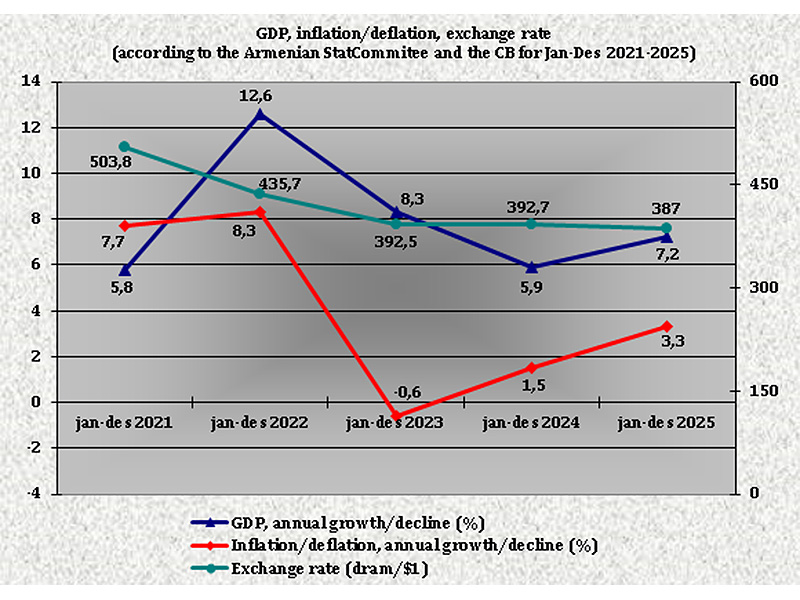
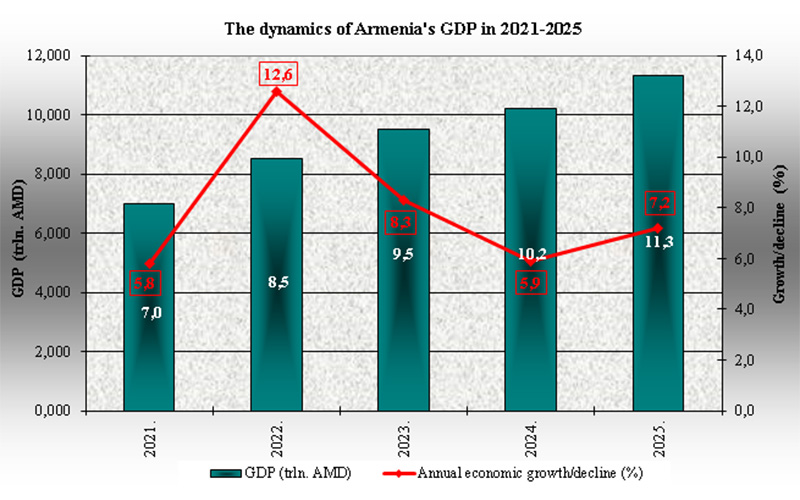
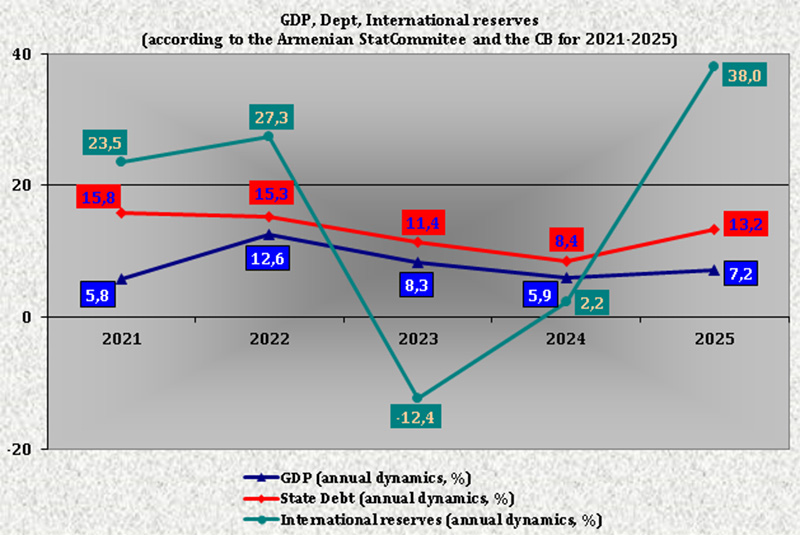
According to statistical data, Armenia's GDP growth slowed down to 8.7% in 2023, after accelerating to 12.6% in 2022 (from 5.8% in 2021).