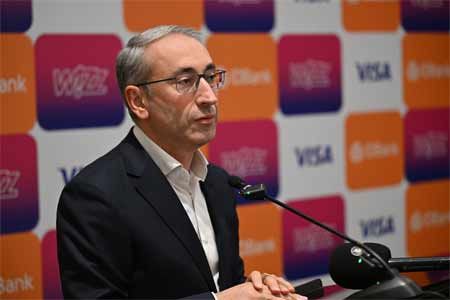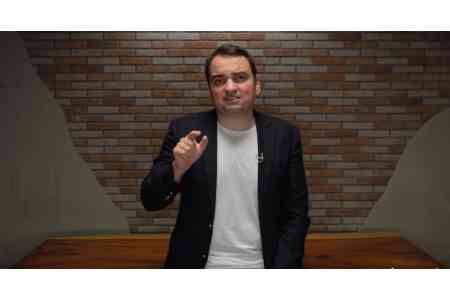


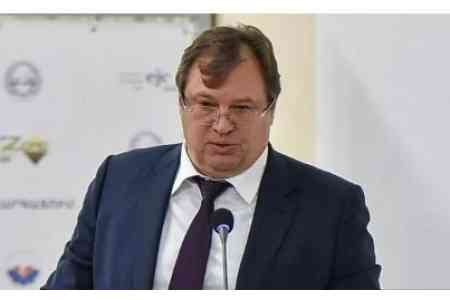
ArmInfo.There are only 34 new copper projects in the world, five times fewer than the number required just for electric vehicle production over the next 25 years. This was stated by Roman Khudoliy, the CEO of the Zangezur Copper and Molybdenum Plant (ZMMK), during his speech at the opening of the Mining Armenia Forum. The Forum was held on the topic of <Modern mining industry: problems and opportunities of Armenia's resources in the context of the global economy>.
Having emphasized that copper production is an important component of Armenia's centuries-old history, he expressed confidence that this will also be its future. The term "critical metals", according to the head of ZMMK, has recently been transformed into the concept of "transition metals". These metals are essential for the transition to renewable energy sources and the so-called green economy. Using electric vehicles as an example, Roman Khudoliy presented how much the demand for copper will increase worldwide. In particular, he emphasized that the production of electric vehicles alone will require 4 times more copper. "To achieve the global goal of electrifying vehicle fleet and producing electric vehicles, worldwide copper production must increase by 80% by 2050. This means approximately 195 new copper projects need to be realized globally", he emphasized.
The CEO of ZMMK stated that today manufacturers of solar panels, wind generators, and electric vehicles are already raising concerns about the scarcity of resources for the transition to a green economy. "No wonder that the world's leading car companies have begun investing in the mining industry, and not only in lithium and cobalt, but in copper. Since copper is now considered a critical transition material," he noted. Roman Khudoliy also pointed out that the ability of companies and countries to use their resources efficiently is crucial amid increasing competition for resources.
The transition to a green economy and decarbonization presents a huge opportunity for countries that were previously less competitive compared to hydrocarbon producers. "Transition metals are new gas and oil for these countries, including Armenia," he said. According to the head of the company, the depletion of rich deposits, a weak geological base, and rapidly advancing technologies are fundamentally altering the view of resources. Therefore, collaboration between the government and companies on issues concerning resource access and investments in exploration projects is of great importance. Moreover, as Khudoliy assured, these are challenges encountered by all mining companies worldwide.
<Less than 1% of exploration projects develop into operational mining projects. Out of 1,000 exploration projects, only 10 will ultimately transition into mining enterprises. That is, for mining companies, exploration geology represents investments with a success probability of less than 1%. Additionally, the timeframe from obtaining an exploration license to extraction and production averages at least 15 years. This makes it one of the riskiest business investment globally. Even the world's leading companies cannot afford such development without collaboration and government support,> he explained.
In this context, the head of ZMMK expressed the opinion that a state program for geological exploration of the subsoil is essential for Armenia's strategic future. He mentioned that the listed challenges, resource base and high environmental and nature conservation standards in the country highlight the importance of cost and competitiveness for mining companies. <In the example of Armenia, it is evident that deposits with small reserves are generally not economically feasible for development. Capital investments in infrastructure, enrichment, and extraction simply do not pay off. New challenges require new approaches, and this is, first of all, the application of new technologies, that rely on science and technology and equipment manufacturers. The use of digitalization, automation, unmanned technologies and artificial intelligence is no longer the future, but the only way to be competitive>, Roman Khudoliy emphasized.
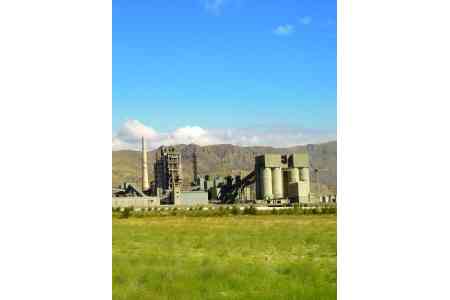
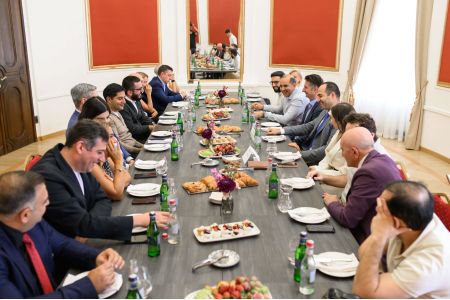
Note that the Mining Armenia Forum was held in Tsaghkadzor from September 27 to 28. The organizer was the Union of Miners and Metallurgists, with the main sponsor being the Zangezur Copper- Molybdenum Combine. Within the framework of the forum, a trilateral memorandum was signed between the Ministry of Territorial Administration and Infrastructure, the Zangezur Copper-Molybdenum Combine and Yerevan State University. According to the document, the parties agree to collaborate in the field of mineral extraction, hydrogeological research and other related work to carry out joint projects. The forum program consisted of reports, panel discussions, interviews, and interactive film screenings about the history of the mining industry in Armenia. Zangezur Copper Molybdenum Combine CJSC (ZMMC) is the largest mining company in Armenia, operating the Kajaran copper-molybdenum deposit. The plant's has ore reserves estimated to last about 150 years and produces molybdenum and copper concentrates. The Molybdenum concentrate contains 50% molybdenum, while the copper concentrate has a copper content of no less than 15%. Currently, the plant processes up to 25 million tons of copper-molybdenum ore and is implementing an investment program to increase production to 40 million tons. ZMMC remains the top major taxpayer in Armenia for the third consecutive year. In particular, in the first half of 2024, the company contributed over AMD 64 billion to the state treasury, which is 83.9% higher than the figure for the previous year. The company was the first company in the country to create and present to the public a full ESG report as a part of its sustainable development and social responsibility strategy.