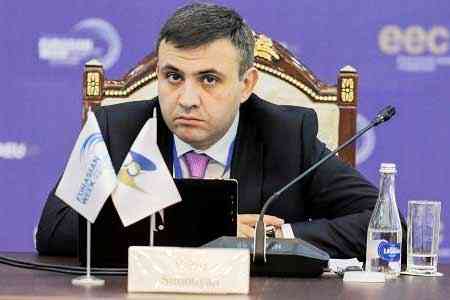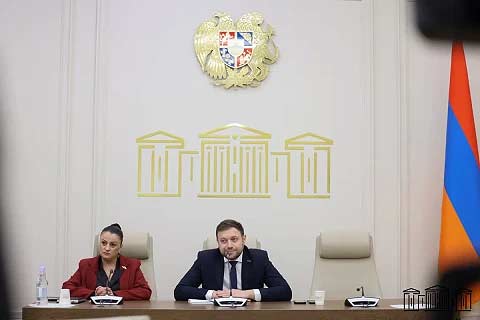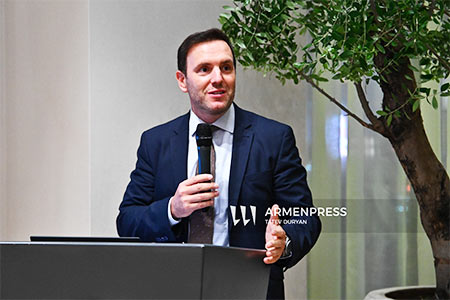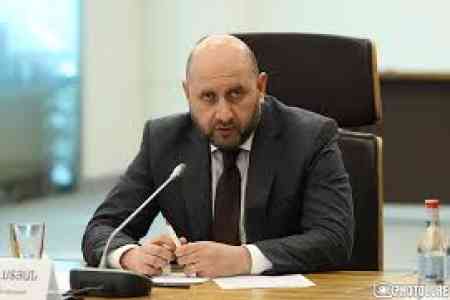
ArmInfo. Economic growth in Armenia in 2025 is projected to be 4.9-5.3%, but recent trends suggest that higher growth rates may be achieved by the end of the year, as stated by Chairman of the Central Bank Martin Galstyan in his speech in parliament on September 9.
He described the conditions that have led to this growth range: "In the first two quarters of 2025, the global economy still faces risks of slowing growth. In particular, the US saw a slowdown in economic growth at the end of 2024, which is due to the uncertainty of prospects against the backdrop of the policy being pursued. Russia has also seen a gradual weakening of economic activity, with growth being driven by domestic consumption, particularly in the services sector. In China, economic growth is also slowing down due to weakening domestic demand. In the Eurozone, economic growth remains low." Galstyan added that inflation in the global market continues to slow down, but in Armenia's trading partner countries, goods and services with rigid prices are still relatively expensive. Food prices in international markets have also risen on an annual basis. Furthermore, there are risks in the international commodity market due to potential disruption in price and supply chains stemming from geopolitical problems in the Middle East in early 2025 and growing tensions in international trade relations. On the other hand, with a further weakening of global demand, deflationary pressure may emerge. "In this context, the central banks of leading countries will most likely maintain relatively tight monetary conditions in the near future," Galstyan believes.
Since the beginning of 2025, economic activity in Armenia has remained at the level of assumed long- term stable growth. In recent months there have even been trends of growth acceleration, which are conditioned, particularly, by noticeably activity in the export sector. Specifically, its about the tourism, IT sector, and the financial sector. During the current year, economic growth continued to considerably contribute to the high growth of the construction sector. Nevertheless, according to Galstyan, the volatility of economic growth is influenced by some short-term factors which contain high uncertainty regarding the sustainability and long-term prospects of economic growth, as well as future trends in domestic demand. "Despite the increased external demand for services in recent months, gross demand from the point of view of inflation is still assessed as neutral. At the same time, support risks remain," he noted.
In August 2025, annual inflation was 3.6%, mainly due to seasonal food products and fluctuating growth in prices of individual components. However, there is still a deflationary influence from outside on prices of non-food products, which is mainly due to lower prices from Chinese manufacturers. In addition, at the beginning of the year, in line with expectations, tariffs in the transportation sector increased. In parallel to this, core inflation, reflecting the cost of non-exportable goods with relatively rigid prices, has remained relatively stable, having formed in recent months at of 2-2.5%. In these conditions, inflation expectations continued to move downwards, approaching the target level (3%, +/- 1 p.p.), which was facilitated by the stable inflation environment that has been maintained for a long time. Further addressing deputies' questions, Galstyan noted that the implementation of such a monetary policy by the Central Bank of Armenia, has achieved high economic growth and stable inflation, compared to neighboring countries,
"It would probably be difficult to imagine a better macroeconomic environment in which there is investment activity in the current geopolitical situation." Regarding the facilitating nature of the Central Bank's policy on the loan portfolio of banks, he noted that in recent years this indicator has demonstrated good growth rates, with 20% provision in the first half of 2025 alone. He also emphasized that the share of toxic loans is now at a historically low level. Speaking about the Central Bank's actions to develop the capital market and the financial sector, he said: "A joint program for the capital market development has been created in collaboration with the government, the Ministry of Finance and the Ministry of Economy, and the Central Bank is the main responsible for the sub-structural component - the creation of a stock exchange platform and the distribution of pension funds.
Regarding the latter, he recalled that a law has been adopted according to which 10% of assets can be directed to the real economy: "I think we will soon witness the first investment and we are talking about promising projects, and the Central Bank has a certain role in this." He informed that the total capital of the banking sector today is 1.8 trillion drams, noting: "There is no other sector of the economy or system with such capital in Armenia." In response to a deputy's question about rates, he said that the refinancing rate is set at 6.75%, the yield on 10-year government bonds is 10%, and the mortgage rate fluctuates on average in the range of 12-13%. "In the region, our interest rates are the lowest, with Georgia showing a similar trend," Galstyan noted.