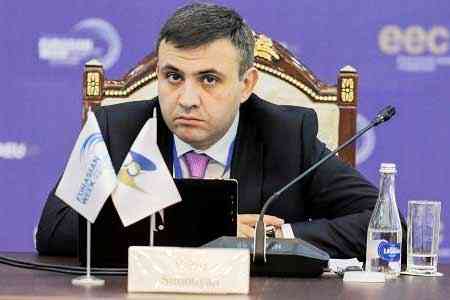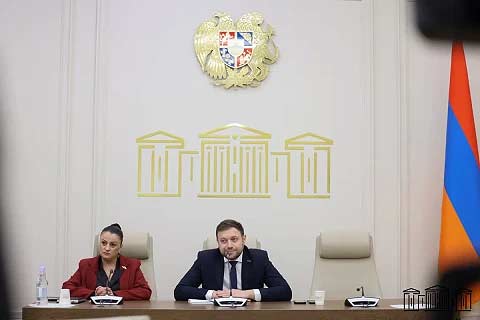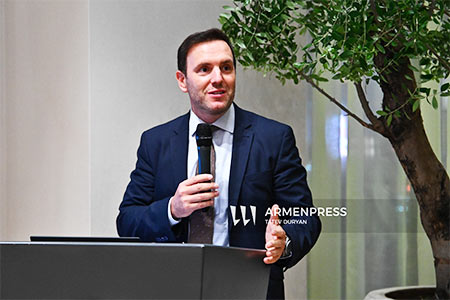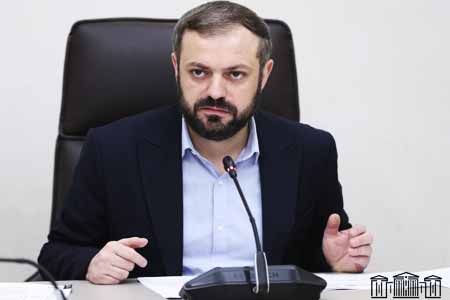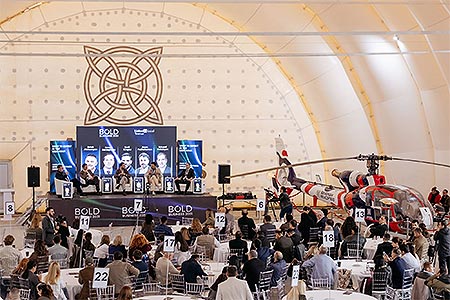


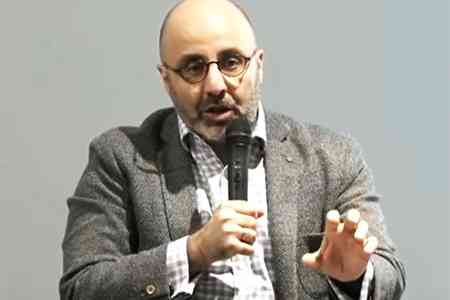
ArmInfo.Circularity is more important for Armenia than for the West, where it is often viewed through an environmental lens. This opinion was expressed by Tigran Jrbashyan, Head of Ameria Management Consulting Service, during a panel discussion on "The Role of Critical Metals for Armenia's Economic and Strategic Sustainability" at the Mining Armenia Forum.
He also noted that the Ministry of Economy lacks understanding that Western countries' approaches to the circular economy differ from those relevant to countries like Armenia.
Given that landlocked Armenia imports a significant portion of its raw materials, Jrbashyan believes it is necessary to build a sustainable model where resources are used as efficiently as possible, fostering economic resilience and reducing dependence on natural resource extraction. In this regard, he noted that Armenia's economy relies on mining and agriculture. The head of Ameria management consulting, noting that circularity is closely linked to innovation and technological progress, emphasized that the latter facilitates the creation and retention of jobs at various levels of the production cycle.
Jrbashyan called for a circular, independent, and resilient economy, where the mining industry becomes a key driver. "A circular approach offers real opportunities, increasing productivity on the one hand, and efficiency on the other," he emphasized.
At the same time, according to the economist, Armenia could establish itself in the global molybdenum market within 5-10 years. In this regard, he noted that Armenia ranks sixth in the world for molybdenum production. Given the metal's longer production chain, the economist believes its importance will increase.
At the same time, Jrbashyan pointed out the lack of research on rare earth metals and zinc. "We don't yet know what we have and what we don't. But we can work on this," he noted.
The expert stated that traditionally, in the context of Armenia, the emphasis is on copper and gold, but, in his opinion, it wouldn't hurt to consider other approaches.
It should be noted that, according to data from the RA Statistics Committee, molybdenum production decreased by 13% in January-August, amounting to 9.9 thousand tons, and copper production decreased by 8.1% to 185.6 thousand tons. Meanwhile, zinc production during the reporting period, by contrast, increased by 6.7%, amounting to 7.5 thousand tons. According to the RA Customs Service, in 2024, Armenia increased copper ore exports by 20.4% to 341,500 tons (compared to a 20.4% decline in 2023). The customs value of copper ore increased by 15.5%, reaching $558.3 million.
Copper ore was primarily exported to China (76.6%), Bulgaria (13.3%), Serbia (2.8%), Switzerland (2.6%), Russia (2.4%), and Iran (2.2%). Smaller shipments were exported to the Netherlands, the United Kingdom, and Australia.
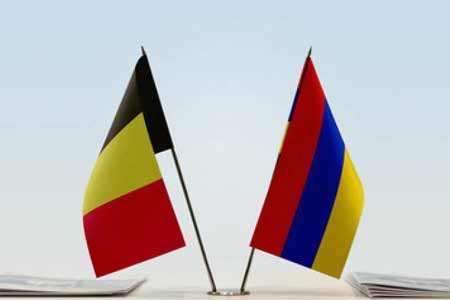
Zinc concentrate exports also increased by 29.6% (compared to a 23.8% decline in 2023), reaching 11,600 tons. At the same time, the customs value increased by 42% to $17.6 million. The entire volume, as in the previous year, came from Belgium.
Molybdenum concentrate exports increased by 2.5% in the reporting year (compared to 8.2% growth in 2023), reaching 11,400 tonnes, with a customs value decline of 4.1% to $220.6 million. Molybdenum concentrate was supplied from Armenia to the markets of Belgium (41.6%), China (17.9%), Russia (13.2%), Hong Kong (7.7%), the Republic of Korea (6.3%), Thailand (5.3%), the Netherlands (4.9%), as well as Slovenia, Austria, India, Australia, and the United Kingdom.
According to statistics, in January-July 2025, production volumes in the mining industry and open pit mines in Armenia decreased by 0.8% year-on-year, amounting to 312 billion drams. Metal ore mining demonstrated a decline of 1.9% to 289 billion drams.