

ArmInfo.The main international financial institutions (IFIs) that have invested in Armenia over the past three years have been the Eurasian Development Bank (EDB) with $329 million, the International Finance Corporation (IFC) with $300 million, and the European Bank for Reconstruction and Development (EBRD) with $244 million.
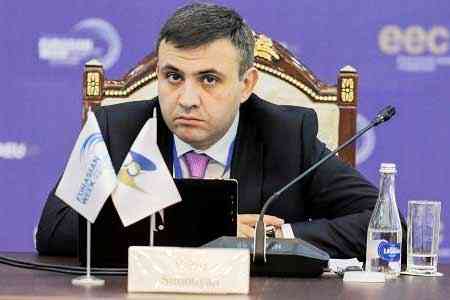
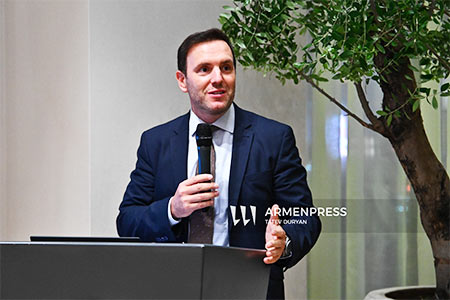
This was reported by Anton Malakhov, Head of the EDB's Center for Analysis of International Finance, while presenting the results of the EDB's new analytical report, "Investing in the Future: Projects of International Financial Institutions in Eurasia."
An EDB expert discussed the status and prospects of non-sovereign IFI financing in Armenia. The volume of approved non-sovereign IFI operations in Armenia for 2008-2024 was: Armenia's share of non- sovereign financing in the Eurasian region increased from 2.3% (2008-2010) to 7.0% (2022-2024). Armenia is among the top 5 countries in the region by volume of financing received.
According to him, the priority sector for IFI investment in Armenia is the financial sector (58%). Other important areas include mining, telecom, hydropower, solar energy, and agriculture. The expert noted that IFI interest in Armenia is growing.
The average annual volume of non-sovereign projects has quadrupled over 17 years. This demonstrates the high confidence of development institutions in the country's long-term economic growth prospects.
As noted in the report, in total, from 2008 to 2024 The volume of approved non-sovereign transactions in Armenia amounted to $3.7 billion.
The average annual financing volume in Armenia increased 3.5-fold, from $108 million in 2008-2010 to $383 million in 2022-2024.
It's worth noting that the European Investment Bank (EIB) has also made significant investments in Armenia in recent years, with non-sovereign financing totaling $217 million. Other IFIs have been more passive. For example, the Asian Development Bank has invested only about $30 million in the Armenian economy, four times less than in Azerbaijan and three times less than in Georgia. The Asian Infrastructure Investment Bank (AIIB) is virtually non-existent in Armenia's non-sovereign financing, although its investments in the economies of Azerbaijan and Georgia are quite substantial: $170 million and $30 million, respectively. The Black Sea Trade and Development Bank (BSTDB) is quite passive in Armenia, with investments totaling only $10 million. The OPEC Fund also invested only $10 million in these years (2022-2024). The International Investment Guarantee Agency also does not operate in Armenia, despite having a sizeable portfolio in Georgia ($36 million).
According to the report, one of the largest IFI projects in the South Caucasus in recent years is the IFC's $250 million investment loan to Ameriabank, Armenia, approved in 2024. This loan is intended to provide loans to micro, small, and medium-sized enterprises (MSMEs), with a 50% climate finance commitment.
It is worth noting that the total approved non-sovereign IFI financing in the Eurasian region for the period 2008-2024 amounted to $74.1 billion. The nominal volume of financing increased by 17.5%, from $4.6 billion in 2008-2010 to $5.5 billion in 2022-2024. The actual volume of non-sovereign IFI financing showed negative trends. The decline amounted to 17.4%, from $4.6 billion to $3.8 billion. Bank analysts believe the main reasons for the decline are accelerating dollar inflation and low rates of nominal financing growth. A decrease in the volume of non-sovereign financing relative to the aggregate GDP of the region's countries was observed, from 0.24% of GDP to 0.19%.