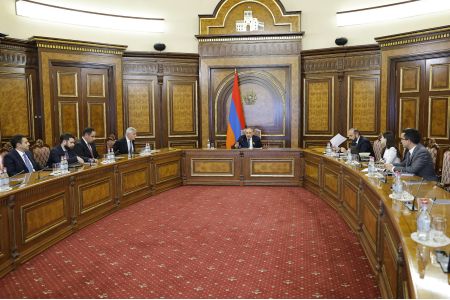
ArmInfo. Narek Ghahramanyan and Sergey Bagratyan, members of the ruling Civil Contract faction in the Armenian Parliament, propose increasing the state duty for issuing licenses, permits, or certificates (or their duplicates) for the import of metal reinforcement from 20 times the state duty to 50 times the state duty. The bill amending the RA Law on State Duty was presented by the initiative's co-author, Narek Ghahramanyan, at a meeting of the National Assembly Standing Committee on Economic Affairs on November 7.
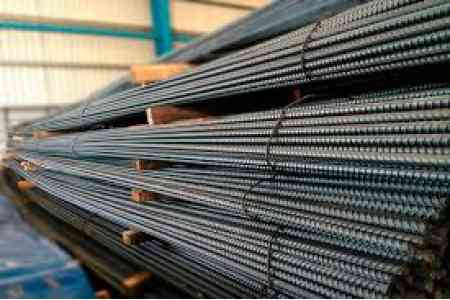
The MP emphasized that this sector is a priority for the government. In this regard, the Cabinet of Ministers has repeatedly extended the ban on the export of ferrous and non-ferrous metal scrap and waste from the country (most recently until August 2, 2026). In addition, a uniform state duty of 29,000 drams per ton was established on the import of finished metal rebar to Armenia from countries outside the EAEU.
However, recently, due to the devaluation of the national currency in Iran and the reduction in the cost of Iranian products, the average weighted customs value of one ton of rebar has decreased by approximately 35,000 drams. This has created an unequal competitive environment for rebar importers and manufacturers.
"With the current decision, we want to balance the situation," Ghahramanyan stated.
Deputy Minister of Economy Edgar Zakaryan acknowledged that local producers are currently facing certain difficulties. Over the past few months, the import cost of metal rebar has decreased by approximately 47,000 drams per ton, he added.
"Our colleagues propose increasing the state duty from 29,000 drams per ton to 55,000 drams." "However, we performed certain calculations to avoid assuming the devaluation of the neighboring country's national currency, and instead to take into account dumping factors that directly impact competition. This led us to a figure of 45 times the current value, meaning a state duty of 45,000 drams," the deputy minister stated.
Opposition faction MP Tadevos Avetisyan, in turn, noted that neither the initiator of the amendments nor the Ministry of Economy took into account the interests of the Armenian consumer in their calculations.
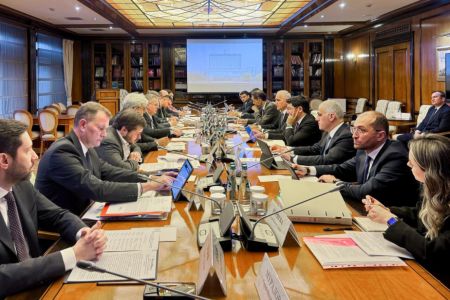
The bill received a positive opinion from the commission and will be included in the agenda of the upcoming plenary session of the National Assembly.
According to statistics, imports of steel rebar from the Islamic Republic of Iran to the Republic of Armenia are steadily increasing. According to earlier studies conducted by the Commission for the Protection of Competition, the average weighted customs value of 1 ton of rebar decreased by 52,000 drams in 2023 compared to 2022, from 269,000 to 217,000 drams. It was noted that the average price of 1 ton of rebar produced in the Republic of Armenia is 259,600 drams, with the minimum and maximum prices being 215,000 and 300,000 drams, respectively.
According to data from the Armenian Ministry of Economy as of the end of October, local metal production volumes increased significantly as a result of the export ban. Specifically, in 2024, the production of unalloyed steel for castings increased by 2.4 times, the production of steel pipes, hollow sections, and their fittings by 10.8%, household goods cast from aluminum by 5.8%, and metal structures and their parts made of iron, cast iron, steel, or aluminum by 19%. As a result of the measures taken by the government, investments were directed into the industry in 2022-2025, including foreign ones (Karakert Stone Smelting Plant, GTB Steel, Dzulakentro, Edmet, Aske Group, Asedl). According to the Ministry of Economic Development's forecasts, the total investment volume for the above-mentioned programs will amount to approximately $100 million, resulting in the creation of 550-750 new jobs, and an increase in the use of local ferrous and non-ferrous scrap metal by 65-70%, bringing the annual scrap consumption volume to 250,000 tons.