

ArmInfo. Investment activity and domestic demand will remain key growth drivers for most countries in the Eurasian region, despite moderate global economic growth and persistently elevated interest rates, according to the Macroeconomic Outlook for 2026-2028, published by the Eurasian Development Bank (EDB).
According to the Bank's analysts, the region's GDP will grow by 2.3% in 2026, with Kyrgyzstan (9.3%), Tajikistan (8.1%), Uzbekistan (6.8%), and Kazakhstan (5.5%) remaining the leaders. "Inflation will continue to slow to 6.4% in 2026, thanks to prudent monetary policy. Investment remains the main driver of growth in the region, particularly in manufacturing and mining, energy, and construction. Commodity markets will move in mixed directions: oil prices will fall slightly, while metals and gold will remain high. The dollar is gradually losing its share of central bank reserves, but its role in settlements remains stable," the EDB forecast states.
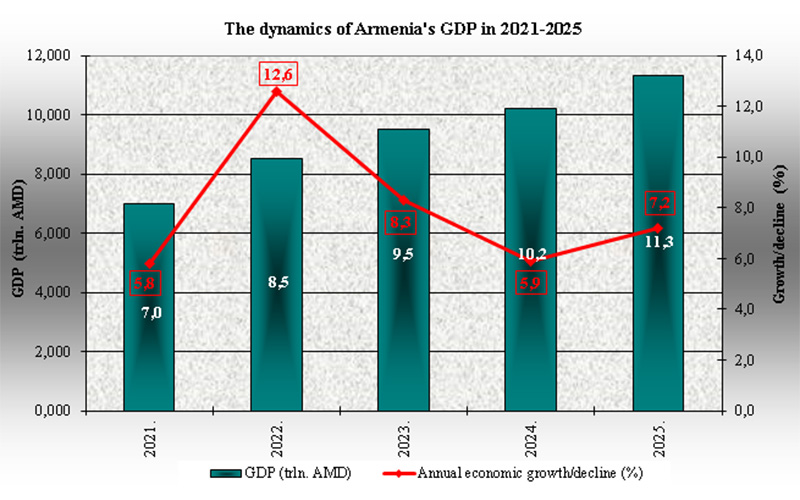
Analysts at the Eurasian Development Bank predict that the aggregate GDP growth rate of the seven member states will be 2.3% in 2026. At the same time, most countries will maintain high economic activity. GDP growth is projected for 2026: 5.3% in Armenia, 1.8% in Belarus, 5.5% in Kazakhstan, 9.3% in Kyrgyzstan, 1.4% in Russia, 8.1% in Tajikistan, and 6.8% in Uzbekistan. However, according to the Bank's analysts, the global economy will grow at a slightly slower rate than in 2024-2025 and will gradually adapt to new trade restrictions. In the United States, growth is expected to be around 1.6% in 2026, amid tariff conflict and high debt levels. The Eurozone economy will grow by 1.1%, mainly due to increased government spending on defense and infrastructure. China will remain the driver: its economy could grow by 4.6% in 2026, supported by government stimulus for domestic demand. Inflation in the US and the eurozone will remain above target levels in 2026-2028. However, interest rate dynamics will differ. In the US, rate cuts will be slow due to rising costs amid tariff conflicts. Meanwhile, according to EDB analysts, the ECB completed its rate cut cycle in 2025 and will begin gradually raising them in 2026-2027.
The Macroeconomic Forecast notes that, after a period of low interest rates in the 2010s, economies have returned to higher, "normal" interest rate levels, characteristic of the pre-cheap money era. This creates additional risks for financial stability and investment, as companies and governments are forced to refinance significant amounts of debt. As a result, interest rates will constrain global economic growth due to increased interest payments and reduced availability of funds for investment. EDB analysts elaborate on this issue in a separate Box 1 of the report. In 2025-2027, mixed dynamics are expected in commodity markets: oil prices will decline slightly due to increased supply, while metal prices will rise due to the expansion of infrastructure projects and the development of "green" energy. Gold prices will remain elevated due to increased demand for it as a reserve asset amid geopolitical instability and the trend toward de-dollarization. EDB analysts also analyzed the changing role of the dollar in the global economy and concluded that the dollar's share of central bank reserves is slowly and steadily declining, but its use in international settlements continues to grow, while its role in credit and deposit transactions remains stable.
"The projected dynamics of the global economy and commodity markets will not create serious obstacles to economic growth in the Eurasian region, but will not become a growth driver either. Lower oil prices will limit export revenues for energy-exporting countries (Kazakhstan and Russia), but will not significantly impact their economic growth. For net oil-importing countries (Armenia, Belarus, Kyrgyzstan, Tajikistan, and Uzbekistan), lower prices will improve terms of trade and help curb domestic price increases," the forecast states. At the same time, it is noted that high gold prices will increase foreign exchange earnings for regional exporters (Kyrgyzstan, Tajikistan, and Uzbekistan). "In 2025, the economy of the EDB region will return to a moderate, equilibrium level after two years of record growth."
According to EDB estimates, the region's GDP will grow by 1.9% by the end of 2025, following 4.5% in 2024. This slowdown is primarily due to the cooling of the Russian economy. At the same time, several Central Asian countries are expected to experience record growth rates by the end of 2025. High growth rates have allowed Central Asian countries to maintain stable external debt levels, despite active capital mobilization. This increases their investment attractiveness compared to other developing economies, where the debt burden has increased significantly," EDB analysts note. They also note that in 2026, the region's economy will continue to grow at a steady pace of 2.3%. "In most countries, growth will remain high thanks to active investment. Inflation will gradually decline towards the target level. Price growth in the region will slow to 6.4% in 2026 from 7.5% in 2025, in the absence of additional shocks, thanks to the prudent monetary policy of regulators in EDB member countries," the forecast states.