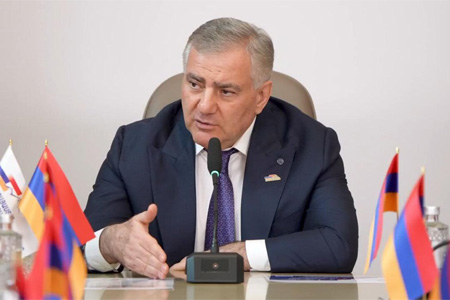



ArmInfo. "This measure does not concern price regulation. It concerns cashback for non-cash purchases using ArCa National Payment System cards," Armenian Deputy Finance Minister Edgar Mkrtchyan stated at a press conference on December 26, answering a question from an ArmInfo correspondent about whether the legislator has provided mechanisms to curb the rise in prices and annual service fees for ArCa cards, given the projected increase in the number of people wishing to purchase these cards, following the Cabinet's adoption of a cashback program for ArCa card purchases.
Yesterday, the Armenian government approved measures and procedures for cashback on non-cash transactions using ArCa National Payment System cards. Starting in 2026, cardholders will receive a 2% cashback. Universal cashback on ArCa cards will be calculated and paid from February 2026 to January 2027 inclusive (until the 25th of the month following the expired reporting period). Cashback will be paid on non-cash purchases exceeding 1,000 drams (slightly over $2.50, ed.), with a maximum of 6,000 drams (over $15, ed.) per transaction and 60,000 drams (approximately $150, ed.) per month. Pensioners and recipients of benefits will also receive an additional 2% cashback on non-cash purchases in addition to the 20% cashback already available to them when paying with an ArCa card. Edgar Mkrtchyan emphasized that cashback will not apply to non-cash purchases from foreign businesses (including online purchases from foreign marketplaces), cryptocurrency services, gambling, utility and communication payments, and payments made to the municipal and state budgets. However, cashback will apply to purchases made from organizations registered in Armenia (including all online marketplaces, if they are residents of the Republic of Armenia).
Cashback will not be awarded for transactions made at high-risk payment points, subscription renewals, purchases and sales of precious stones/metals, non-cash payments to financial institutions, or for any gift cards or purchases using cashback already received.
When asked about the reason for this "discrimination" and why cardholders of other payment systems cannot be beneficiaries of the program, Mkrtchyan stated that the reason is that, according to the program's terms, the cashback amount is determined proportionally: 1% from Armenian Card CJSC, a partner participating in the program, and 1% from the state budget. It should be noted that the funding provided by Armenian Card CJSC for the program is limited to 3.5 billion drams. If the expenses incurred for providing cashback during the program exceed this amount, then, according to a decision by the Cabinet of Ministers, the program will be fully funded from the state budget. According to Edgar Mkrtchyan, the possibility of issuing co-branded cards, such as MasterCard with ArCa, is currently being discussed. If such cards are issued, cashback will also apply to transactions made with these cards.
According to the latest data from the Ministry of Finance, the Deputy Minister indicated that there are approximately 500,000 plastic cards of the ArCa National Payment System in the republic. However, the Deputy Minister assured that the system is prepared for a possible influx of people wishing to purchase ArCa cards, although he urged citizens not to "attack the system" all at once.
According to Issue N32 of the analytical review "Armenian Banks in the Card Business," prepared by ArmInfo Information Agency, there were 4.7 million cards in the Armenian plastic card market as of October 1, 2025, a 15% year-on-year increase. Local ArCa cards accounted for only 16.3%, or 770,302 units, and their number has been declining by 5% annually for the second year running. This decline is partly due to the process that began two years ago, when two banks (IDBank, effective September 2023, and Unibank, effective January 2024) discontinued issuing local cards. Unibank, having held the lead in the number of national cards for many years, abruptly abandoned them in favor of international systems. Other banks also saw little growth in local card adoption, despite their low prices and tariffs, and a stable market niche among the elderly and those receiving pensions and benefits.
In this situation, Armenian Card, in order to take local ArCa cards to a new level of technological functionality, has been implementing high-tech solutions one after another. These include: Starting in 2024, the ability to accept and pay ArCa cards online via the EMV 3DS 2.0 EPS domain of Armenian Card, ensuring the security of online ArCa card payments for all Armenian banks, regardless of their platform of processing; starting in November 2024, the ArCa Pay system for instant express payments; and starting in October 2025, the ArcaQR system for everyday payments using a QR code directly from a bank account. The Central Bank, in turn, introduced a requirement to ensure interoperability for payments or transfers using QR codes (a single QR code image installed by banks and payment institutions at points of sale and/or services) starting in October 2025.
Armenia's national payment system (NPS), Armenian Card (ArCa), has been providing technological support to banks for over 25 years, including card processing, payment solutions, and interbank services. ArCa also operates the ArcaPay instant transfer system and the recently introduced unified national QR solution, ArcaQR. Armenian Card's shareholders are the Central Bank of Armenia (55%) and 15 of the 17 banks operating in Armenia (excluding Iran's Mellat Bank and VTB Bank Armenia), which equally distribute the remaining 45%.