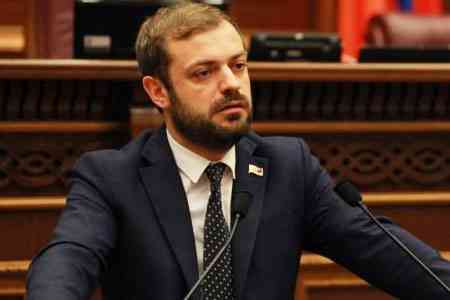


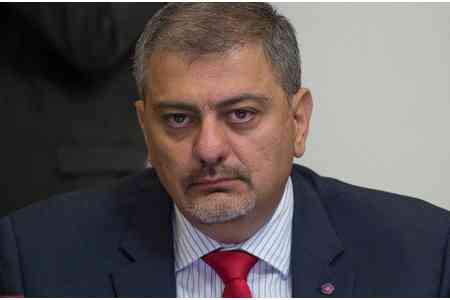
ArmInfo.Former Deputy Prime Minister of Armenia, former Minister of International Economic Integration and Reforms Vache Gabrielyan does not see any elements of blackmail in the statements of large retail chains of the republic that the authorities' desire to return network supermarkets to the legitimate tax field can lead to higher prices and unemployment. "There are objective bases for raising prices, but to what extent they will affect pricing, it is impossible to say today," Gabrielyan said in an interview with ArmInfo.
According to the expert, he cannot talk about what exactly were the agreements between economic entities and the State Revenue Committee, and how they were observed. Nevertheless, as he pointed out, the previous government was faced with the task of providing the villagers with the opportunity to sell their products to large trading networks, and, at the same time, to document the turnover. "The former Armenian governments in the economy with numerous small business entities consistently sought to bring the model tax legislation in line with the structure of the economy, but since this is not done immediately, the most important task that the authorities tried to solve was to document the trade turnover, because it is the basis of transparency, and it was within this logic that the government acted, "he said.
At this stage, as Gabrielyan noted, the most important task is still to ensure full documentation of the trade turnover of large retail chains. However, for this, from the point of logic of the continuity of the VAT chain, it is necessary to visualize the incomes of the agricultural sector as well. The last to date continues to be outside the field of VAT regulation. In this context, very often legal entities VAT payers in the process of agricultural procurement are faced with the problem of the lack of a mechanism for calculating VAT and in order to avoid higher prices than non-paying taxpayers of this type of tax, or avoid trade with small agricultural producers or distort trade.
According to the expert, today it is difficult to assess how significant the price increase may be, since VAT is not the only factor affecting prices. However, the most important is the objective task from the point of view of the legislation, based on the lack of application of VAT on agricultural producers. Already after the trade in agricultural products in supermarkets will be fully transferred to the VAT field, an assessment of the ability of sellers and buyers to "carry this load" can be given. "The main task is to find the optimal solution to the problem, so as not to cause damage to the agricultural producer and the end user," he said. Vache Gabrielyan stated that, of course, it is necessary to be guided by the current legislation. At the same time, he shares the opinion of the leadership of the State Revenue Committee of Armenia that it is necessary to thoroughly analyze the data and make a final decision on the situation as a result of public discussions. It's not a secret for anyone that it is noted that in the whole world, hidden turnover often lurks where there are self-employed citizens and small farms. And this is not the "prerogative" of Armenia - even in countries with the best administration, the lowest level of tax specifics is present in the agricultural sector and among self-employed persons. "Thus, if there is a desire to ensure full tax transparency, and to reveal all the hidden revenues, it is necessary to move the agricultural sector intelligently into the tax field," the expert concluded.
To recall, the heads of 11 retail networks recently sent a letter to the Prime Minister of Armenia, Nikol Pashinyan, expressing concern about the possible risks associated with the further functioning of points of trade in the light of the GDP inspections and the requirement to work within the framework of the law. Having welcomed the government's policy aimed at bringing this segment of large-scale trade to the legal field, they noted that the operation of the networks was thereby threatened. At the same time, they announced the need for an urgent review of tax legislation. Nevertheless, independent experts saw in this a note of blackmail and sabotage from large supermarkets.