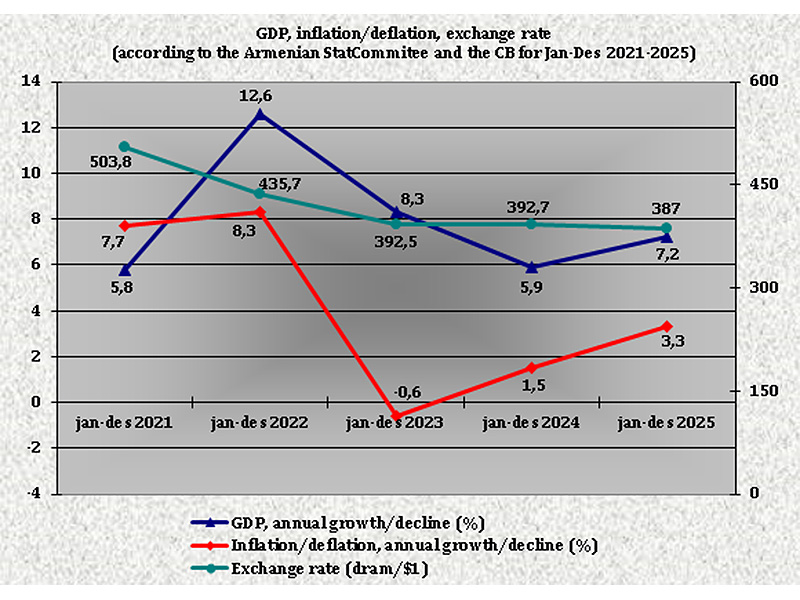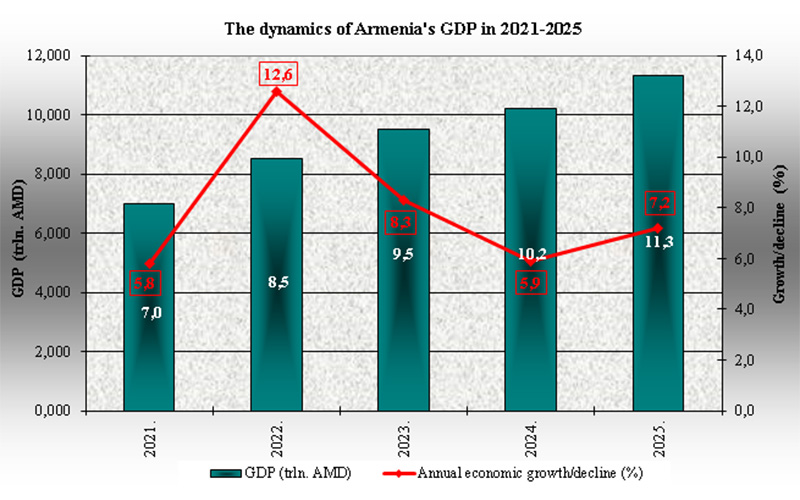


ArmInfo. By the end of 2022, Armenia's GDP growth will reach 12-13%. At the same time, experts estimate the potential growth rates of the RA GDP at 4-4.5%.
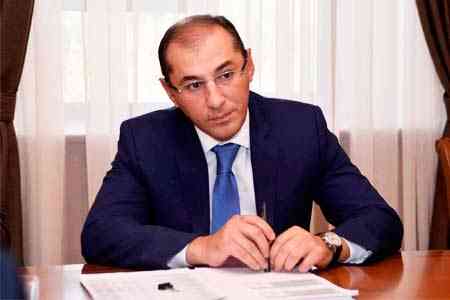
The current growth is due to temporary factors related to the development of the situation around Ukraine. In the long term, we will not be able to grow faster than this potential without some serious transformations, increased investment activity, the growth of the export-oriented sector, and if the geopolitical situation changes, we risk being left with nothing. Former Minister of Finance of Armenia, international consultant on public finance management Vardan Aramyan, made this assessment in an interview with ArmInfo.
- Mr. Aramyan, according to the draft state budget for 2023, the economic growth in Armenia in 2022 is projected at the level of 11%, against the 7% planned by the state budget. At the same time, the other day, Tigran Khachatryan, Minister of Finance, during the presentation of the document in Parliament, said that growth is likely to be revised upwards, based on statistical data for January-September 2022. Prime Minister Nikol Pashinyan himself announced the prospect of closing the current financial year with a 14% GDP growth. Meanwhile, over the past 20 years, the highest GDP growth rate was recorded in 2005 at 13.9%. Can Armenia set a new record?
Despite the fact that the statistical data of this year's January-September 14.1 percent annual growth in economic activity sounds very nice, in reality they carry significant risks, since they are caused by external factors - the growth of visitors with "their wallets", financial flows, parallel trading etc..
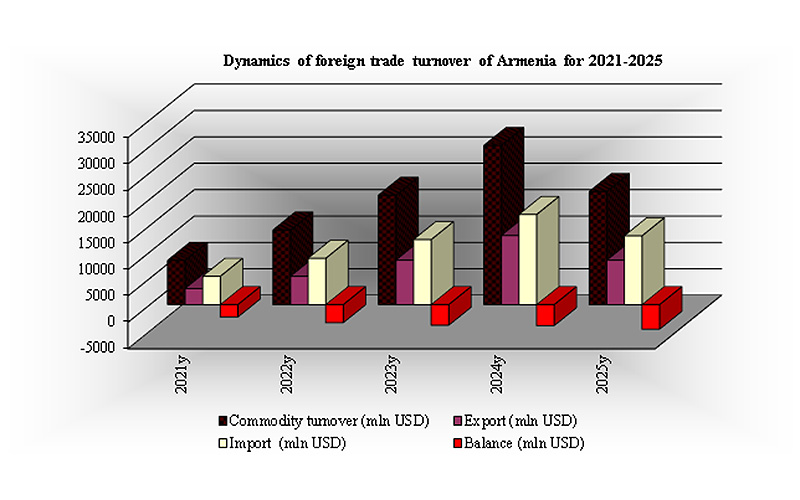
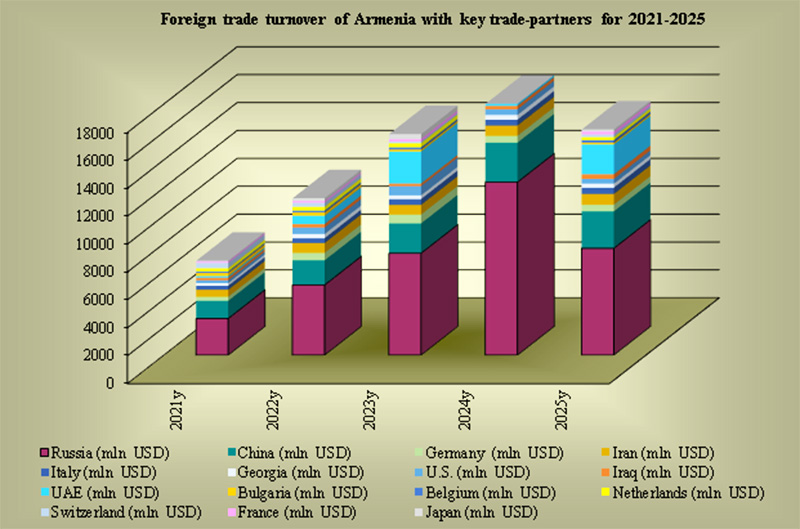
Thus, the growth of economic activity during 9 months was due to the service sector - 27.1%, the trade sector - 14.5%, construction - 14.3%, the industry, which reached a double-digit growth of 10%, and the agricultural sector experienced a decline of 0.7%. The foreign trade turnover of Armenia increased by 62.5% per annum.
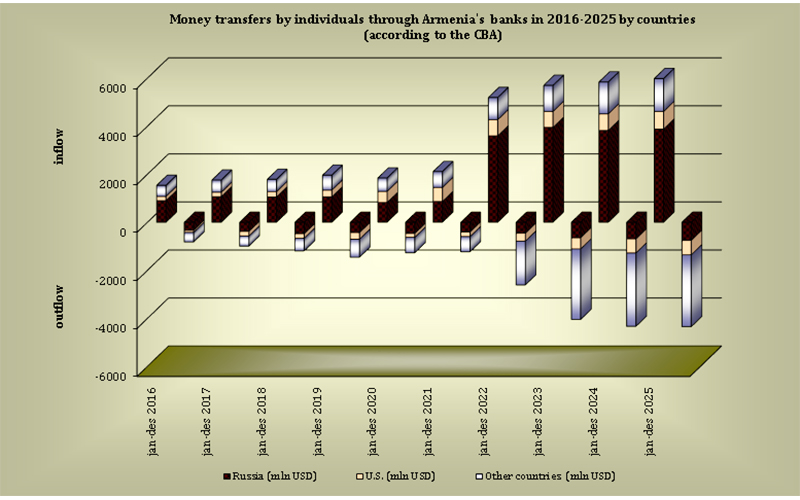
At the same time, the inflow of private transfers to Armenia in January-September of this year reached a historical maximum - $3 billion 461.6 million were transferred to the accounts of individuals from abroad through the banks of the Republic of Armenia, which is $1 billion 924.8 million more than in 2021 and $2 billion 183.1 million more than in 2020. This growth was provoked by a significant increase in the inflow of transfers from Russia (3.7-fold - up to $2.3 billion). At the same time, the outflow of transfers from Armenia increased 2-fold- up to $1.8 billion. As a result, the net inflow of private transfers to Armenia increased 2 .6-fold in y-o-y terms - up to $1.7 billion. Moreover, the net inflow of transfers from Russia, having increased 5.8-fold, reached $2.01 billion, and from the USA - by 1.5% alone to $282.4 million.
During the same period, 1 million 240 thousand tourists visited Armenia, compared to 619 thousand visits for the same period in 2021. Almost half of them are visitors from Russia - 567,429 people (49% of the total number of tourists).
Thanks to the abovementioned, I think that by the end of 2022 Armenia will reach double-digit economic growth - in the amount of 12-13% or even slightly higher. Should this be considered exclusively an Armenian phenomenon? Definitely not. The economy of neighboring Georgia grew by 10.2% in the first nine months of 2022.
Is this growth solely the result of certain actions of the Armenian government? Again, no, and as soon as the external factors contributing to this growth weaken or cease, our economy will face significant difficulties. It is difficult to say when this will happen, after a year, two or three, since this is directly related to geopolitical developments. But the fact that we have demand-driven economic growth is a fact, and it is dangerous.
- According to the draft state budget for 2023, GDP growth next year will be 7%. As the head of government said in the National Assembly on November 2, after a 14% growth in 2022, it will be difficult to ensure a 7% growth in 2023, "but it can be solved." At the same time, according to the forecast of the Central Bank, GDP growth in 2022 will be 12.9% with a slowdown in 2023 to 4.5%. Meanwhile, the IMF recently reduced its global economic outlook for 2023 to 2.7% from 2.9% forecasted in July. It was noted that the economic slowdown in 2023 will affect everyone: it is expected that the growth of the countries that account for a third of the world economy will decrease this year or next year. In short, the worst is yet to come. And for many of us, 2023 will be associated with a recession. What is your forecast, against this background, how realistic is it for Armenia to ensure a 7% growth next year, given the high base in the current one?
If we are sure that the factors contributing to the growth of the economy in 2022 will remain in 2023 as well and will even grow to a greater extent, then yes, even taking into account the high base, Armenia will be able to ensure a 7% GDP growth.
Let's not forget that the potential for generating GDP in Armenia, according to various estimates, is approximately 4-4.5%. If we had an increase in productivity due to the fact that we once seriously invested in some fantastic know-how, due to which the RA would move to a qualitatively new level, and which would allow the republic to claim even 7-8 % growth instead of 3-4%, then yes, we have the right to claim growth above the current potential.
But, when considering the factors that determine the current growth which are mainly exogenous factors, it becomes obvious that 11% growth is clearly above our potential. At the same time, in order to ensure a 7% GDP growth in 2023, after 11% in 2022, these factors should not only remain, but also intensify.
Let me remind you that this kind of growth was noted in 2001-2008: if in 2001 Armenia registered an economic growth of 9.6%, already from 2002 to 2008 the RA economy recorded double-digit rises. In particular, the indicator in 2002 reached 12.9%, 14%- in 2003, 10.5% in 2004, 13.9% -in 2005, 13.2 %- in 2006, 13.7%- in 2007. Already in 2008, the rate fell to a single-digit 6.8%, and a decline of 14.2% was recorded in 2009. This once again proved in practice the elementary truth that growth not supported by remittances and potential from abroad is not sustainable, (more than $5.3 billion entered Armenia in 2004-2008 through the banking system alone, ed. not) . In particular, the non- tradable sector takes precedence over the trade sector, which leads to high economic growth, while a significant increase in the productivity of the exported sector is not expected.
To avoid such a negative economic development, the authorities had to aggressively tax the "thriving" non-commercial sector, particularly construction, in the first decade of the 2000s, thereby reducing the profitability of this sector and preventing the non-trade sector from strangling the trade sector and stealing its resources.
Indeed, it is impossible for Armenia's economy with its small volumes to ensure a high level of economic stability against external shocks as well as sustainable growth in the long term only due to the high growth of the non-tradable sector of the economy and domestic resources. Therefore, if we cannot periodically increase the supply of our goods and services to the outside world better than others, we will have to forget about the prospect of sustainable economic growth.
Today there is almost a similar situation, with the only difference that at that time the whole world was booming. Meanwhile, today, while the rest of the world announces an approaching recession, the countries interconnected with Russia, such as Kazakhstan, Georgia, and Armenia, are experiencing economic recovery. And, if in 2002-2008 the cycle lasted 9-11 years, today it may be shorter, and the Armenian government needs to respond to risks promptly. Otherwise, the Armenian economy runs the risk of being left alone with its problems.
- And how can we avoid repeating the negative scenario of 2002-2008? The current government should revise its tax policy; start a more aggressive administration, especially in areas that are booming under the influence of external factors, in order to "cool" them. These decisions are unpopular, but necessary.
Then, financial resources should be directed to solving problems that ensure the strengthening of economic potential in the long term, including in the field of defense. After all, no one will dare to open a business with long-term investments in a country where the implementation of the 4 pillars of economic stability - fiscal, monetary, political and security, is not ensured. Without an appropriate policy, the growth of the Armenian economy in 2023 and in the future will depend on temporary factors: on the weakening or strengthening of anti-Russian sanctions, as well as other geopolitical factors. Thus, even if we consider that a greater confrontation between Russia and the West is expected in the future, it may mean an even greater flow of Russian immigrants and their capital for Armenia. In this case, we can state with confidence that the 7% GDP growth in 2023 is realistic even after this year's 14-15% growth, yes realistic, but dangerous for the future of Armenia's economy.
But, since nothing lasts forever, even sanctions, which at some point may exhaust themselves, the situation is not so rosy for the Armenian economy - and sooner or later the Armenian economy will have to face the harsh reality.