

ArmInfo. The Eurasian Development Bank (EDB) has developed a database of non-sovereign financing, which contains investments of international financial institutions (IFIs) coming to the countries of the Eurasian region. It contains more than 1,700 projects of international financial institutions in 11 countries of the Eurasian region over the past 16 years, detailed by 50+ parameters.
The new analytical project of the EDB is called the Non-Sovereign Financing Database (NSF Database). The database will be updated quarterly and can be used for operational monitoring and analysis of non- sovereign financing in the region.
Non-sovereign financing of IFIs is aimed at stimulating the economic development of countries and regions. The importance of non-sovereign financing for the economies of the Eurasian region is due to the absence of a burden on the state budget, promotion of the development of the private sector and attraction of additional resources of the private sector.
The EDB database aggregates publicly available information on non-sovereign operations of IFIs, including the Asian Development Bank (ADB), the Asian Infrastructure Investment Bank (AIIB), the Eurasian Development Bank (EDB), the European Bank for Reconstruction and Development (EBRD), the European Investment Bank (EIB), the New Development Bank (NDB), the Black Sea Trade and Development Bank (BSTDB), the International Bank for Economic Cooperation (IBEC), the International Investment Bank (IIB), and the International Finance Corporation (IFC).
The NSF database provides governments and the expert community of the Eurasian region with a complete picture of non-sovereign investments from international financial institutions coming into the region. Evgeny Vinokurov, Chief Economist of the EDB, emphasized the practical benefits: "It is very easy to use the database and dashboard. Based on the database, you can create analytical samples by instruments, sectors, currencies, and many other project parameters. Separately, it is possible to analyze green projects of IFIs in the region. You can evaluate the effectiveness of projects. In addition, the NSF database contains projects since 2008, which means that it is possible to identify long-term trends in development funding. This is valuable for formulating public policy on development funding.
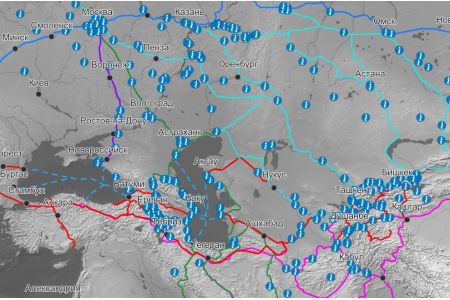
Currently, the database covers MFI operations in the following countries of the Eurasian region: Azerbaijan, Armenia, Belarus, Georgia, Kazakhstan, Kyrgyzstan, Mongolia, Russia, Tajikistan, Turkmenistan and Uzbekistan. The database contains information on 1,712 MFI operations in these countries for the period from 2008 to 2023. The database allows you to rank and search for projects, in particular, by the following parameters: recipient countries; names of MFIs and borrowers; financing sectors; project implementation stages; financing volumes in transaction currencies; project performance and environmental effects. The EDB database will be useful: for development institutions - when expanding their activities in the region; for representatives of companies and government agencies - to improve interaction with MFIs and shape state policy on development financing; for experts and the academic community - for an in-depth quantitative analysis of MFI activities in the region; for journalists - when preparing materials on the Eurasian region and, in particular, on Central Asia.
The Eurasian Development Bank (EDB) is a multilateral development bank implementing investment activities in the Eurasian region. For over 18 years, the EDB has been promoting the strengthening and expansion of economic ties and the comprehensive development of its member countries. The EDB's authorized capital is USD 7 billion. The EDB's portfolio mainly consists of projects with an integration effect in the areas of transport infrastructure, digital systems, green energy, agriculture, industry and mechanical engineering. In its activities, the Bank is guided by the UN Sustainable Development Goals and ESG principles.